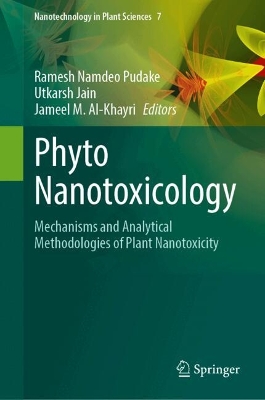
Engineered nanomaterials have become relevant in large-scale industrial applications and are used in many common devices and products. Their intentional and non-intentional release into the environment may have negative effects in terms of the health of humans and plants. There is increasing concern about nanotoxicity in plants because they are not only a fundamental part of the ecology but also the basis of trophic systems. Nanotoxicology is the branch of toxicology responsible for describing the effects of nanomaterials on living organisms and the environmental consequences resulting from their use. Thorough studies are important because nanomaterials have stronger toxicological effects than those reported for the same materials in bulk or in solution. The main toxicological factor observed in various organisms is oxidative stress. Many techniques have been used to evaluate the toxicity of nanomaterials in plants; however, currently, there is no consensus on the optimal method for evaluating toxicity in plants. A concern is that bioaccumulation of nanoparticles in plants can enter the food chain of animals and humans, constituting a health problem. Therefore, extensive safety research projects and regulations are urgently needed. This volume focuses on the mechanisms and analytical methodologies that are important in plant nanotoxicity and reviews the present status of the nanomaterials that might be directly and indirectly encountering plants. It discusses the characterization of nanomaterials in pristine form and complex biomolecules. The properties of ENM that are important for plant growth or toxicity, and the techniques to study the physiological and molecular impacts on plant bioprocess, are summarized in this volume. Studies on new omics technologies like transcriptomics, proteomics, and metabolomics for a deeper understanding of plant nanotoxicology are also discussed. The book serves as a valuable reference source for graduate students, researchers, academicians, and scientists of plant science and nanotechnology. It is a reference book for undergraduate and graduate students in life science disciplines as a bridge between textbooks and recent scientific literature, providing an in-depth knowledge of phyto-nanotoxicology.
Author Biography
Dr. Ramesh Namdeo Pudake is an Assistant Professor in Amity University Uttar Pradesh - one of the top-ranked private universities in India. Dr Pudake is a PhD in Crop Genetics and Breeding from China Agricultural University, Beijing, PRC. After his PhD, he is engaged in research in a range of organisms but with a focus on genomics and nanobiotechnology. He has also worked in the Department of Agronomy at Iowa State University Ames, IA, USA on host-pathogen interaction and gene mapping. Currently, he is focusing on research on different applications of genomics, and nanomaterials in agriculture. Dr Pudake has published 50 research publications, 9 books, 30 book chapters. He also has one scholarship award from the Chinese Government for pursuing his doctoral studies. He is a guest editor and expert reviewer for several journals of repute. Dr. Utkarsh Jain achieved his PhD in Medical Microbiology from Ludwig Maximilian University of Munich (LMU), Germany in 2014. He elucidated the role of Store-operated calcium entry (SOCE) channel proteins STIM1 and ORAI1 after infection with Helicobacter pylori VacA toxin in T-lymphocytes. After his PhD, he joined the Indian Institute of Science (IISc), Bangalore, India as a Postdoctoral Research fellow. Later, he contributed as a Group Leader – Cell Culture, Navya Biologicals, and Application Specialist at Carl Zeiss, Germany in the Microscopy products division. He worked at Amity University Uttar Pradesh, Noida, India as Assistant Professor during 2016 -2022. Presently he serves as Senior Associate Professor, UPES, Dehradun, India. He has published more than 100 research papers and has secured 9 research projects from notable funding agencies in India and the UK including BIRAC, DST, SERB, UKEREI, and DBT. He secured himself a Top 2% of World Scientists by Stanford University. He has presented his work at more than 50 international conferences in different countries, filed 20 patents, published 9 book chapters, and edited 2 books. In addition, he was rewarded as an Outstanding Plus Researcher and academician, the Young Scientist Award, Best Extramural Research Award, and Best Poster and Oral Presentation awards at Paris and India. He has awarded 4 PhD students and 25 Research Students for their various Dissertation projects. Presently, 6 PhD students are working under his supervision. He is a reviewer of various International and national high-quality research journals. His field of research is the development of various biosensing-based detection platforms for detection associated with pathogenic diseases. Prof. Jameel M. Al-Khayri is affiliated with the Department of Agricultural Biotechnology, King Faisal University, Saudi Arabia. He received B.S. in Biology in 1984 from the University of Toledo, M.S. in Agronomy in 1988, and Ph.D. in Plant Science in 1991 from the University of Arkansas. He is an active member of the International Society for Horticultural Science and serves as the National Correspondent of the International Association of Plant Tissue Culture and Biotechnology. He dedicated his research efforts to date palm biotechnology for the past three decades. Al-Khayri has authored 182 research articles, 116 chapters, and edited 12 journal special issues and 52 reference books on plant biotechnology, genetic resources, breeding, genomics, nanotechnology, climate change, and food security. He was recognized in the top 2% of Scopus Citations in 2022-2024. Currently, he is the editor of two Springer Book Series, Advances in Plant Breeding Strategies, and Nanotechnology in Plant Sciences. He has been involved in organizing international scientific conferences and contributed numerous research presentations. In addition to teaching, student advising and research, he held administrative responsibilities as the Assistant Director of Date Palm Research Center, Head of Department of Plant Biotechnology and Vice Dean for Development and Quality Assurance. Al-Khayri served as a Member of Majlis Ash Shura (Saudi Legislative Council) for the 2009-2012 session. He is interested in biotechnological approaches in agricultural innovations and sustainability to support food security.






Reviews
There are no reviews yet.