


We ship worldwide - see checkout for options

Exceptional customer service trusted by 100's
£86.95
We ship worldwide - see checkout for options
Exceptional customer service trusted by 100's
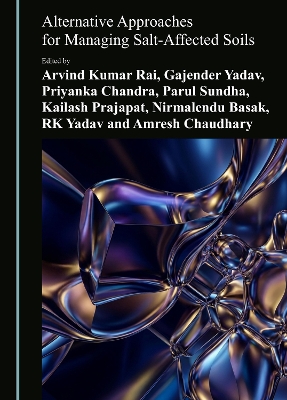
Worldwide, nearly 932.2 million hectares of land are salt-affected (SAS). Salt accumulation in the soil is a major contributing factor to land degradation, losses in agricultural productivity, and impeding societal development and livelihood. The high salt accumulation negatively affects soil’s physical and chemical environment and poor soil microbial activities. Broadly, there are two categories of SAS. The first one is defined as “alkali soil”; this type of soil carries disproportionally large quantities of exchangeable Na+ and may or may not carry a large concentration of soluble electrolytes. To restore these soils, external supply of Ca2+ from different sources are advocated. Development of new formulations using advanced approaches are the researchable issue for efficient reclamation of alkali soil. The second category of SAS soil defined as “saline soil” has excess accumulation soluble electrolytes originated from the native parent material or enriched from the secondary sources. These soils are further associated with multiple problems of the underground shallow water table or for provisional inundation with brackish/seawater intrusion.This book aims to bring out a comprehensive collection of scientific research which includes traditional and new age technologies for management of salt-affected agroecologies.This book will be useful for researchers, students and planners working in the area of salt-affected soils.
| Weight | 0.8361704 kg |
|---|---|
| Author | |
| Editor | |
| Photographer | |
| Format | |
| Illustrators | |
| Publisher |
Only logged in customers who have purchased this product may leave a review.

Paperback / softback
Original price was: £20.00.£17.95Current price is: £17.95.In Stock

Paperback / softback
£19.95
Hardback
Original price was: £20.00.£16.95Current price is: £16.95.In Stock

Paperback / softback
£31.95
Paperback / softback
£135.00
Paperback / softback
£27.00
Spiral bound
£12.95
Hardback
£114.95
Reviews
There are no reviews yet.