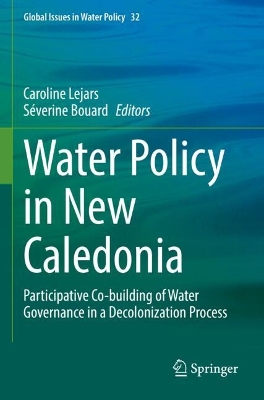

Water Policy in New Caledonia: Participative Co-building of Water Governance in a Decolonization Process

£99.95

Usually dispatched within 6-10 days

Water Policy in New Caledonia: Participative Co-building of Water Governance in a Decolonization Process Editors: Séverine Bouard, Caroline Lejars Format: Paperback / softback First Published: Published By: Springer International Publishing AG
string(3) "270"
Pages: 270 Illustrations and other contents: 38 Illustrations, color; 20 Illustrations, black and white Language: English ISBN: 9783031881985 Categories: , ,

In 2018, a few months before the first referendum for full sovereignty, the government of New Caledonia launched the co-design of the country’s first water policy based on a broad consultation that involved 1 out of 600 New Caledonians, the locally so-called “Shared Water Policy”. The book both presents and assesses the original and broad participatory process used to build the new water policy. It does so by crossing different points of view (government, local managers and customary authorities). The book is also devoted to bridging the gap between customary land studies and water policy. It seeks a way to weave water representations and customary water management practices into the new policy.   This experience in a unique decolonisation complex context will inspire policy makers, academics, managers working on participatory methodologies for more inclusive water policy and governance processes, especially in countries where indigenous populations and legal pluralism orders coexist.

Weight0.5135925 kg
Author
Editor
Photographer
Format

Illustrators
Publisher

Reviews

There are no reviews yet.

Only logged in customers who have purchased this product may leave a review.

“This volume, Water Policy in New Caledonia, offers a timely and thorough analysis of water governance in one of the world’s most politically and environmentally complex regions. … Water Policy in New Caledonia makes an important academic contribution. … This book will interest scholars of water governance, indigenous rights, and postcolonial studies, as well as practitioners involved in policy design in multicultural and resource-dependent settings.” (Nahid Samimi, Water Economics and Policy, Vol. 11 (3), 2025)

Author Biography

Caroline Lejars is a researcher at CIRAD (International Cooperation Center for Agricultural Research for Development) and currently deputy director of a research unit on Water Management (UMR GEAU) in Montpellier. Her research focuses on the governance and management of hydrological territories mainly in North Africa and the Pacific. Most of her research is based on participatory approaches to support the organization of collective action. She has carried out and directed various research projects on groundwater governance, water contracts and arrangements and participatory planning for water policies. She was a lecturer at AgroParistech (2009–2010), associate professor at the National Agronomic Institute Hassan II in Morocco (2011–2016) and at the New Caledonian Agronomic Institute (2016–2019). Séverine Bouard is a Human Geographer (PhD). Her research focuses on assessing the extent of agriculture and hunting/fishing among Indigenous Pacific livelihoods in the context of the commodification of nature and emerging Indigenous discourses on nature and places. She focuses on the trajectories of people and territories, highlighting social change at work. She has taken part in, or led, more than ten research programmes on natural resource management and has developed a research practice deeply rooted in fieldwork. Her aim is to understand and co-design public policies with stakeholders that are based on and respectful of indigenous ontologies and livelihood strategies. Together with Caroline Lejars, they led the research programme GOUTTE (Water on Governance on Customary Lands in New Caledonia), on which this edited volume is based. After twenty years of research at IAC in New Caledonia, she has joined the Department of Environmental Management at Lincoln University (NZ) in May 2025.