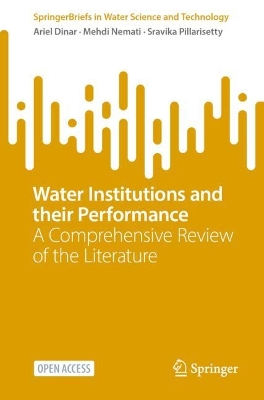

Water Institutions and their Performance: A Comprehensive Review of the Literature

£24.95

Available for Pre-order. Due June 2026.

Water Institutions and their Performance: A Comprehensive Review of the Literature Authors: , , Format: Paperback / softback First Published: Published By: Springer Nature Switzerland AG
NULL
Illustrations and other contents: 2 Illustrations, color; 1 Illustrations, black and white Language: English ISBN: 9783032246486 Categories: , , , , ,

This open access book provides the motivation to the work, realizing that water availability and its quality have become limiting factors for economic growth of various nations and leading to inefficient use of water and loss of welfare. Increased impacts of various processes, including intensification of climate change impacts on various water-dependent sectors, population growth, and a rise in standards of living in different parts of the world calls for institutional interventions that were proven successful in recent years and various places. The monograph reviews the development of various institutions in the water sector, implemented under different contexts, time periods, scales, types of water use, and several other specifications. The Introduction describes also the organization of the monograph.

Weight0.5 kg
Author

, ,

Editor
Photographer
Format

Illustrators
Publisher

Reviews

There are no reviews yet.

Only logged in customers who have purchased this product may leave a review.

Author Biography

Ariel Dinar is a Distinguished Professor Emeritus of Environmental Economics and Policy in the School of Public Policy and Professor of the Graduate Division at the University of California, Riverside (UCR). His work addresses economic and strategic behavior associated with management of water and the environment. Dr Dinar worked at the World Bank on water and climate change economics and policy. In 2008, Dr Dinar assumed a professorship at UCR and founded and directed the Water Science and Policy Center. He has been a Fulbright Senior Specialist since 2003 and was named a 2015 Fellow of the Agricultural and Applied Economics Association. During his nearly half a century of engagement in water, agricultural and environmental economics work he published/co-published 35 books, 208 peer reviewed papers in leading water, agricultural and environmental economics journals, and 57 book chapters. Mehdi Nemati is an Assistant Professor of Environmental Economics and Policy at the University of California, Riverside’s School of Public Policy, where he also directs the Water Dialogue Lab. His research applies advanced econometric and data-driven methods to pressing water-management and environmental-policy challenges, with a particular focus on California and the greater Colorado River Basin. Dr. Nemati collaborates closely with water agencies, utilities, and regional governments to translate rigorous empirical evidence into actionable policy solutions that enhance water affordability, resilience, and sustainability. He has secured more than $2 million in competitive research funding from federal, state, and foundation sources, and his work regularly informs public discourse through media outlets such as The Los Angeles Times, CNBC, and MIT Technology Review. Dr. Nemati’s scholarship spans the intersection of water economics, climate adaptation, and behavioral policy design. His peer-reviewed publications, appearing in journals such as Resource and Energy Economics, Land Economics, and Water Resources Research, investigate topics ranging from urban water affordability and conservation behavior to the economic impacts of land subsidence and drought. He is a co-author of forthcoming chapters in the Oxford University Press and Edward Elgar volumes on climate change and transboundary water management. Sravika Pillarisetty is a third-year undergraduate student at the University of California, Riverside (UCR), studying Public Policy on the pre-law track. She is concurrently a Master’s in Public Policy at UCR, aiming to bridge the gap between the development of policy and its implementation as law using both the MPP and JD to work in government and policymaking. While she has worked in the legal sector to help underserved populations, she has also focused on policy work in the housing, envinmental, and social justice sectors to bridge the said gap. By using a legal lens to analyze policies and institutions, she identifies efficient and unique perspectives for solutions and research.