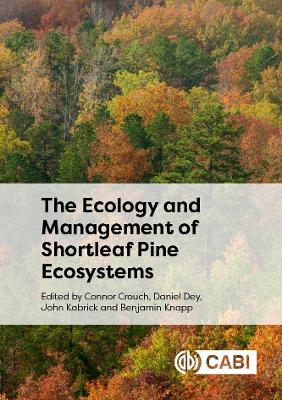

The Ecology and Management of Shortleaf Pine Ecosystems

£145.00

Available for Pre-order. Due November 2026.

The Ecology and Management of Shortleaf Pine Ecosystems Editors: Connor Crouch, Daniel C. Dey, John M. Kabrick, Benjamin Knapp Format: Hardback First Published: Published By: CABI Publishing
string(3) "488"
Pages: 488 Language: English ISBN: 9781800627406 Categories: , , , , , , ,

The Ecology and Management of Shortleaf Pine Ecosystems is the first range-wide, comprehensive book about shortleaf pine (Pinus echinata). This edited volume features the perspectives of leading scientists and managers from diverse disciplines throughout shortleaf pine’s range in the eastern and southern USA. It synthesizes information on shortleaf pine ecology, including a review of historical influences on shortleaf pine’s distribution, ecological classification frameworks, and the species’ regeneration ecology and stand development pathways. Separate chapters address topics that include describing understory plant communities and wildlife species associated with shortleaf pine ecosystems, as well as silvicultural systems and fire regimes suitable for managing shortleaf pine ecosystems. The book discusses a variety of interdisciplinary management considerations, from economics and human dimensions to genetics and forest health. It concludes by providing practical guidance on how to manage shortleaf pine in a variety of real-world scenarios, including plantations, silvopasture, open woodlands and savannas, pine-oak mixedwoods, and old-growth forests. This book is intended for forest, fire, and wildlife managers, ecologists, silviculturists, scientists, students, and others who have the pleasure of working in shortleaf pine ecosystems.

Weight1.0492 kg
Author
Editor
Photographer
Format

Illustrators
Publisher

Reviews

There are no reviews yet.

Only logged in customers who have purchased this product may leave a review.

Author Biography

Connor Crouch (Edited By) Dr Connor Crouch is a Forester with the USDA Forest Service, Northern Research Station in Columbia, Missouri. He received his undergraduate degree in journalism and MS in natural resources from University of Missouri and his PhD in forest science from Northern Arizona University. Connor's research focuses on issues of forest health and the role that silviculture can play in helping forests adapt in an increasingly uncertain future. Daniel C. Dey (Edited By) Daniel C. Dey is an award-winning scientist and Assistant Director for Research at the US Forest Service Northern Research Station. His research evaluates silvicultural practices to manage forests that produce the wide array of goods and services. He specializes in solving forest regeneration issues in hardwood-dominated forests in both uplands and bottomlands. He has done extensive work with collaborators on determining historic fire regimes in oak/pine-dominated ecosystems throughout the Eastern US. This knowledge is the basis for developing management guidelines that combine prescribed fire with thinning and harvesting to restore native forest communities, including woodlands and savannas. He has authored more than 250 scientific and technical publications dealing with these topics, including work in North America, South America and Europe. John M. Kabrick (Edited By) John Kabrick is the unit leader of the US Forest Service research group of the Northern Research Station headquartered in Columbia, Missouri. He is the recipient of prestigious national and regional awards for his work. John has academic degrees in both soil science and forestry, and he teaches a graduate-level course on forest soils. His current research includes management of mixed woods, with particular emphasis on forests that are mixtures of oaks and pines. He also studies carbon dynamics in hardwood and mixed-wood forests with emphasis on understanding the implications for carbon storage and climate change. Additionally, John investigates the effects of prescribed fire and other management practices on the restoration and maintenance of oak savannahs and woodlands. Benjamin Knapp (Edited By) Dr Benjamin Knapp is an Associate Professor of Silviculture and Interim Director of the Center for Agroforestry in the School of Natural Resources at the University of Missouri. He received his BS in forestry at Purdue University and his MS and PhD degrees in forestry at Clemson University. Through understanding ecological processes, his research seeks to refine silvicultural practices to address contemporary issues, often related to restoration or conservation objectives. Specific research topics include tree regeneration, fire ecology and the use of prescribed burning as a silvicultural tool, and understanding how disturbances, through management or natural, affect stand dynamics.