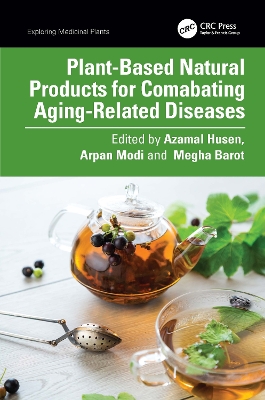
Plant-Based Natural Products for Combating Aging-Related Diseases explores the growing role of medicinal plants and plant-derived bioactive compounds in promoting healthy aging and managing aging-associated disorders. As life expectancy increases worldwide, chronic conditions such as cardiovascular diseases, diabetes, neurodegenerative disorders, arthritis, and skin diseases continue to challenge healthcare systems. This book highlights how plant-based therapeutics may provide safer, multi-targeted, and sustainable approaches for improving healthspan and quality of life. The book presents current advances in pharmacology, phytochemistry, molecular biology, nutrigenomics, biotechnology, and herbal medicine research. It discusses important phytochemicals such as curcumin, resveratrol, quercetin, berberine, flavonoids, and polyphenols, along with their roles in oxidative stress, inflammation, cellular senescence, and metabolic regulation. As part of the Exploring Medicinal Plants series, this title covers topics from aging biology to functional foods, herbal formulations, nanotechnology, and disease-specific applications, serving as a valuable resource for researchers, healthcare professionals, academicians, and students interested in aging research and natural product therapeutics.
Author Biography
Professor Azamal Husen is an eminent academic and researcher whose career spans over two decades of outstanding contributions to teaching, research, and scientific leadership. His academic journey has been marked by distinction and international engagement, having served as Full Professor and Head of the Department of Biology at the University of Gondar, Ethiopia, and Foreign Delegate at Wolaita Sodo University, Ethiopia. In India, he is currently an Adjunct Professor at Graphic Era University and has previously served as Professor at Sankalchand Patel University, Visnagar, Gujarat. His research has been supported by several prestigious national and international organizations, such as the World Bank, National Agricultural Technology Project, Indian Council of Agricultural Research, Indian Council of Forestry Research and Education, and the Japan Bank for International Cooperation. A prolific scholar, Prof. Husen has authored a vast number of research papers, books, and book chapters published by leading international publishers. His commitment to advancing global science is reflected in his editorial and peer-review work for numerous high-impact international journals. His expertise has been widely acknowledged through invitations to evaluate book proposals for leading global publishers such as Springer, Taylor & Francis, and Elsevier, as well as to review research projects for prestigious international funding agencies, including the Czech Science Foundation (Czechia) and the National Research, Development and Innovation Office (Hungary). He is a Fellow of the Plantae Group under the American Society of Plant Biologists and a member of several prestigious scientific organizations, including the International Society of Root Research, the Asian Council of Science Editors, and the International Natural Product Sciences Taskforce. Throughout his distinguished career, Prof. Husen has been a keynote and invited speaker at numerous international conferences and symposia. He has played a significant role in academic development, contributing to curriculum design, faculty training, and educational module development across undergraduate, postgraduate, and doctoral programs. His outstanding achievements in teaching, research, and community service earned him special recognition from the University of Gondar. In the realm of scientific publishing, he serves as Editor-in-Chief of the American Journal of Plant Physiology and as Series Editor for several globally recognized academic collections, including Exploring Medicinal Plants, Plant Chemistry, Plant Biology, Sustainability, and Climate Change, Smart Nanomaterials Technology, and the Handbook Series on Nanotechnology and Its Applications. Consistently recognized among the World’s Top 2% Scientists (2020 onwards) by Stanford University, Prof. Husen has also served as Guest Editor for several influential special issues, including Advances in Plant Metabolomics (Plant Physiology and Biochemistry), Exploring Nanotechnology in Medicinal Plants (Journal of Herbal Medicine), Integrating Nanotechnology with Plant Compounds (Frontiers in Plant Science), and Nanobiotechnology for Sustainable Agriculture and Crop Improvement (Discover Applied Sciences), among others. Through his scholarly excellence, editorial leadership, and global collaborations, Prof. Husen continues to advance cutting-edge research at the intersection of plant science, nanotechnology, and sustainability, establishing himself as a leading figure in contemporary biological and environmental research. Dr. Arpan Modi is a director of Axenic Agritech Private Limited, Ahmedabad, India since July, 2023 and heading a molecular diagnostic unit at Paws Universe Superspeciality Veterinary Hospital, Ahmedabad, India since March, 2025. He is also a guest faculty at the Department of Biotechnology, School of Energy Technology, Pandit Deendayal Energy University, Gandhinagar. He has been a part of various trainings and workshops for the skilled development of graduate and post-graduate students in the area of plant tissue culture. As a director in Plant Tissue Culture Unit, he is leading the production of 250,000 tissue culture-raised Banana plants every year. He has five years of experience as a post-doctoral fellow from Agricultural Research Organization, Volcani Center, Israel and 7 years of experience as a researcher in the area of Plant Biotechnology and Biochemistry. In his research tenure, he had worked on diversified plant species like Stevia, Date palm, Papaya, Sandalwood, Ficus microcarpa, Fig, and Apple. He has edited a book on Plant Tissue Culture and editing 3 books, two of which with CRC Press and one with CABI publisher. He has 16 research papers, 5 review papers and more than 30 book chapters in his publication list with the cumulative impact factor of 30.55. Dr. Megha Barot is currently serving as an Assistant Professor (Research & Development Cell) in the Department of Environmental Science at the Parul Institute of Applied Sciences, Parul University, Vadodara, Gujarat, India. She brings more than a decade of professional experience spanning environmental science, life sciences, and clinical diagnostics. Her academic and research interests lie at the intersection of marine ecology, environmental biotechnology, plant sciences, and sustainable resource management. Dr. Barot has made significant contributions to the study of marine biodiversity, particularly focusing on seaweed diversity and their ecological and economic significance along the western coastal regions of India. Her research has involved extensive field surveys and documentation of seaweed flora from ecologically sensitive coastal zones, where she has recorded nearly 200 species of seaweeds along with their seasonal variations. Her work also incorporates modern molecular approaches, including DNA barcoding, to accurately identify and characterize these species and to better understand their biodiversity and evolutionary relationships. In addition to biodiversity studies, Dr. Barot has actively explored the nutraceutical, agricultural, and environmental applications of seaweeds. Her research includes evaluating the potential of selected seaweed species as biofertilizers and plant growth stimulants through controlled ex situ experiments on regionally important crops. These studies contribute to the growing interest in sustainable agriculture and the utilization of marine bioresources as eco-friendly alternatives in crop production systems. Dr. Barot has published several research articles in peer-reviewed journals focusing on marine ecology, seaweed biology, and environmental applications of marine resources. She has also played an important role in national scientific initiatives and served as the National Coordinator for the Bio-Innovation Ignition School (BIIS) program at SRISTI under the Department of Biotechnology – Biotechnology Industry Research Assistance Council (DBT-BIRAC), Government of India. Prior to joining academia, she worked as a Junior Scientist and NABL Internal Auditor at the Neuberg Centre for Genomic Medicine in Ahmedabad, where she gained valuable experience in clinical diagnostics, laboratory quality management systems, and genomic technologies. Her contributions to environmental research have been recognized through several honors, including the Research Contribution Award from the Gujarat Cleaner Production Centre (GCPC), Government of Gujarat, for her work on seaweed diversity and its potential applications. She has also enhanced her international research exposure through specialized training at Xiamen University, China. In addition to her research activities, Dr. Barot has contributed significantly to academic publishing. She has served as editor and co-editor of seven scholarly books published by reputed international publishing houses and has authored numerous book chapters and research papers. Through her research, publications, and collaborative initiatives, she continues to contribute to the advancement of environmental science, marine biodiversity conservation, and sustainable utilization of natural resources.






Reviews
There are no reviews yet.