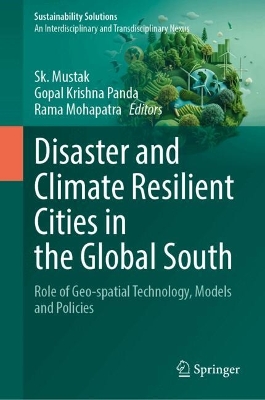
Various studies of the Intergovernmental Panel on Climate Change (IPCC) have been reporting that global warming is reaching to a point of irreversibility. Changing pattern of extreme weather events with increasing magnitude and frequency are going to be the greatest challenge of the 21st century. Cities across the world are already showing vulnerabilities to climate change and extreme weather events. Global south is the most rapidly urbanizing part of the world with more than 75% of the world’s urban population residing in this region. UNO has warned that rapid urbanization in global south could expose billions of people to the impacts of global warming, climate change and increasing incidences of climate induced hazards and disasters. Impact of climate change and associated hazards has become important to identify appropriate strategies, improved communications, and relevant management options derived from appropriate scientific tools, techniques and methodological investigations. Urban Climate adaptation and mitigation are crucial for dealing with climate-related extreme events on a worldwide scale to achieve the sustainable development goals of disaster resilient towns and cities. Cities in the Global South are more exposed to such risks because of their sprawling unplanned urban development, lack of adaptive capacity and socio-economic vulnerability.
Author Biography
Dr. Sk. Mustak is an Assistant Professor at Dept. of Geography, Central Univ. of Punjab, Bathinda (India). Prior to this he has served as Research Associate and Research Coordinator at Ecoinformatics Lab, Ashoka Trust, Bangalore during 2018-2020.•He obtained M.Sc. in Geoinformation Science and Earth Observation from ITC, University of Twente, Netherlands and PhD in Urban Geography with specialization in application of Advanced Remote Sensing and Artificial Intelligence from Pt. Ravishankar Shukla Univ.,Raipur, India.•His main research area is in Applied Earth Observation and Geoinformatics, applications of artificial intelligence in Urban and Regional Planning and Landscape Ecology. and international travel grants from DST-SERB in 2009 2013 and 2014 and has received research grants from the Central University of Punjab, Bathinda in 2020. He has presented 19 research papers in national and international conference and published 15 research papers in national and international peer-reviewed journals, book, and proceedings (SCI and Scopus indexed). He is a reviewer in several journal of the national and international reputes. Prof. Gopal Krishna Panda is working as Emeritus Professor in the Post Graduate Dept. of Geography, School of Tribal Resource Management at KISS (Kalinga Institute of Social Science, Deemed University), Bhubaneswar and was former Prof and Head of the Dept. of Geography of Utkal Univ., Bhubaneswar, Odisha, India. •He has obtained Masters and Ph. D from Utkal Univ., Bhubaneswar and, Certificate Course in Remote Sensing, Photogrammetry and Cartography from the National Institute of Remote Sensing (Dept. of Space, Govt. of India), Dehradun, Uttarakhand, India. •Received Emeritus Fellowship of UGC in the year 2016 and honored with the Senior Fellowship of ICSSR, New Delhi in 2019 and Visiting Fellow of the Liverpool School of Tropical Medicine in 1995. Under his guidance 16 students have been awarded Ph. D degree in geography and environmental science. •He has been the editor of two important books published from the Springer Nature i.e., Indigenous Knowledge in Disaster Risk Reduction, Landslide Susceptibility and Risk Reduction and one from Elsevier i.e. Indigenous People and Nature. Prof. Rama Mohapatra is an expert in applications of GISc (Geographic Information Science), remote sensing technologies, econometrics, and machine learning to model geographical data. Overall, he has more than 25 years of teaching and research experience in the field of GISc. This is his 14th year at Minnesota State University, Mankato. His primary role at Minnesota State University involves teaching numerous GISc classes, serving as thesis adviser, guiding students on their internships, and supervising graduate and undergraduate student research projects. Apart from his teaching and research, Prof. Mohapatra is also involved in many committees and professional organizations. • Prof. Mohapatra obtained his Ph.D. degree in Geography from the University of Wisconsin – Milwaukee in 2012. His dissertation title was “Monitoring and modeling urban growth using remote sensing and GIS technologies.” Prof. Mohapatra completed his bachelors and masters (MA and MPhil) degrees in geography from the Utkal University, Odisha, India. He has several journal publications, presented in numerous conferences, and is involved in many research projects and books.









Reviews
There are no reviews yet.