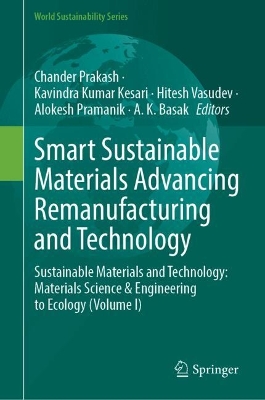
This book aims to provide a leading forum for sharing original research contributions and practical developments in SMART and sustainable materials and their advancements in remanufacturing to contribute its share for technological advancements. The theme of this book series “SMART” basically defines its title “Sustainable Materials Advancing Remanufacturing and Technology.” In this series, Volume I of this book entitled “Sustainable Materials and Technology: Materials Science & Engineering to Ecology” is dedicated to the use of technology in material science and transformation into sustainable materials. The Earth’s resources are being impacted by the growing need for advanced materials, modern manufacturing processes, and industrial practices that are detrimental to the environment by leaving carbon footprints, using up energy resources, producing garbage, etc. Applications based on functional materials are becoming more and more significant due to recent advancements in material science and technology. Functional materials for sustainable energy applications provide a crucial manual for creating and using these materials in sustainable energy production. The fields of materials science, nanoscience, engineering, and nano/technology are responsible for a fourth industrial revolution in which the world is witnessing how technology is merging digital, biological, chemical, and physical spheres of global human activities. Although, the field has shown great potential to help mankind satisfy the global demand of clean water. Nanofibrous membranes offer promising and improved efficiency in terms of purifying water. Also, cellulose films have been found very useful material to replace plastic. Considering these points, this book explores that how could societies across the world meet their current basic human needs, aspirations, and desires, without compromising the ability of future generations to meet their own needs? Because, technology is not free from drawbacks, and it creates severe problems in the environment.
Author Biography
Prof. Chander Prakash is working as Professor at the School of Engineering and Pro-Vice Chancellor, research, ranking, and accreditation at Geeta University, Haryana, India. He is also associated as Project Head at the Research Laboratory of 3D Bioprinting Technologies for Flexible Electronics, Institute of Nanotechnology, Electronic and Equipment Engineering, Southern Federal University, Taganrog, Russia. He is a passionate researcher with diversified research interests—developing materials for biomedical and healthcare applications, additive manufacturing, and developing and exploring new cost-effective manufacturing technologies for biomedical industries. To date, he has published more than 585 scientific articles in various peer-reviewed, reputed top-notch journals, conferences, and books in Materials Science and Manufacturing. He is a Highly Cited Researcher at the international level, and he has 18600 citations, an H-index of 75, and an i-10 index is 318 (as of January 2026). He edited/authored 40 books, serving as Series Editor of 3 books, Editorial Board Member of journals. He is among India’s Top 1% of leading mechanical and aerospace engineering scientists, as per Research.com. He holds the 38th rank in India and 1,590th rank in the world. He also consistently appeared in the top 2% of researchers as per the Stanford Study in 2021, 2022, 2023, and 2024. Dr. Kavindra Kesari is a senior researcher in the Department of Applied Physics, Aalto University and the University of Helsinki, Finland. He obtained a doctoral degree in Biotechnology and received Junior and Senior Research Fellowships during his doctoral studies at Jawaharlal Nehru University, New Delhi, India. He is actively involved working in material-based neuro and cancer biology research. He has published over 150 papers (H-index 36: Google Scholar) in reputed scientific journals, 30 book chapters, and 7 books and presented over 40 papers at national and international scientific meetings. He has been acting as a commissioner at the ICBE EMF, USA, since 2021, and an honorary faculty member for NGCEF, New South Wales, Australia, since 2020. Hitesh Vasudev is working as a professor in the Department of Mechanical Engineering, Lovely Professional University (LPU), Phagwara, Punjab, India. He has received his Ph.D. degree from Guru Nanak Dev Engineering College, Ludhiana, India. His research areas include surface engineering/thermal spraying. He is currently working on the development of nanostructured materials and hybrid materials. He has won the Research Excellence Award for three consecutive years (2019, 2020, and 2021) at LPU. He has published over 100 indexed papers, 15 conference papers, 4 books, and 25 book chapters. He also consistently appeared in the top 2% of researchers as per Stanford Study in 2023. Dr. Alokesh Pramanik is currently a senior lecturer in Mechanical Engineering, School of Civil and Mechanical Engineering at Curtin University, Australia. His area of research is synthesis/development, surface modification, and advanced/precision machining of metallic and non-metallic biomaterials. Synthesis and development of magnesium-based biodegradable and titanium-based alloys and composites, respectively, using innovative manufacturing techniques such as spark plasma sintering, electrospinning, and 3D printing. He has published over 150 research articles in the peer-reviewed international journals, conference proceedings, and book chapters. His h-index of 44, i-10 index of 117, and total citations of 6851 strongly endorse his high research productivity. He has published 10 books with Springer and CRC Press—Taylor & Francis Group and 10 edited books are under progress. He has authored one book. He is also acting as a guest editor of 5 international peer-reviewed journals. Dr. Basak graduated in 2002 with a B.Sc. in Metallurgical Engineering degree from Bangladesh University of Engineering and Technology (BUET), Dhaka, Bangladesh, with honors. Upon the completion of master’s and Ph.D. degrees in Materials Science and Engineering from Katholieke Universiteit Leuven (KULeuven), Belgium, he started working in different Australian universities. His research interests include nanostructured materials, high-resolution electron microscopy and probe analysis, nanoscale fabrication of materials, deformation mechanisms of novel materials, nanomechanics, tribology and tribocorrosion, electrochemistry and electrochemical measurement techniques. He has published more than 50 research articles which are well cited in this area.






Reviews
There are no reviews yet.