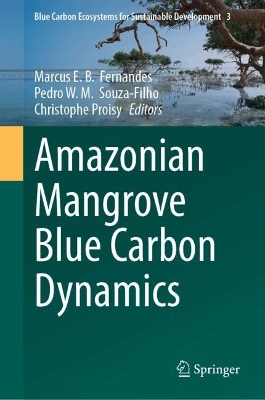

Amazonian Mangrove Blue Carbon Dynamics

£149.95

Available for Pre-order. Due May 2026.

Amazonian Mangrove Blue Carbon Dynamics Editors: Marcus E. B. Fernandes, Christophe Proisy, Pedro W. M. Souza-Filho Format: Hardback First Published: Published By: Springer Nature Switzerland AG
string(3) "291"
Pages: 291 Illustrations and other contents: 38 Illustrations, color; 16 Illustrations, black and white Language: English ISBN: 9783032186034 Categories: , , , , ,

This book unveils the critical role of Amazonian mangroves in the global fight against climate change in this groundbreaking exploration of blue carbon dynamics. This book provides an in-depth analysis of the carbon storage and emission processes intrinsic to the largest continuous mangrove area on the planet. From photosynthesis in mangrove species to live and dead wood dynamics, the authors present innovative research on biomass estimation and the most accurate estimates of carbon stocks in Amazonian mangroves. The book combines field-based measurements with advanced remote sensing technologies, unveiling precise allometric models and high-resolution carbon mapping techniques. It highlights the intricate interplay between tidal water flows and greenhouse gas emissions, revealing their impact on the carbon balance of these unique forests. This volume bridges science and policy with its holistic perspective, offering actionable insights for conservationists, scientists, and decision-makers. It underscores the Amazonian mangroves’ indispensable role in mitigating climate change and proposes integrated management, education, and conservation strategies. Essential for understanding and preserving the planet’s most extensive mangrove system, this book is a call to action for safeguarding one of Earth’s most valuable carbon sinks in the face of global climate challenges.

Weight0.55183875 kg
Author
Editor
Photographer
Format

Illustrators
Publisher

Reviews

There are no reviews yet.

Only logged in customers who have purchased this product may leave a review.

Author Biography

Marcus Emanuel Barroncas Fernandes (born 1962) is an ecologist specialized in vegetation and animal interactions with abiotic variables in the mangrove ecosystem. He is a Full Professor of Ecology at the Universidade Federal do Pará (UFPA), Brazil. His major research fields include biodiversity–ecosystem functioning relationships in Amazonian mangrove forests and the use of socio-environmental approaches to assess the different ecosystem services these systems provide to traditional communities. His research aims to understand how anthropogenic drivers affect mangrove health and sustainability. In line with sustainability principles, he also works with participatory resource management and mangrove restoration initiatives along the Amazonian coast, integrating scientific research with community-based conservation practices. Pedro Walfir Martins e Souza-Filho (born 1971) is a geologist specialized in coastal geology, remote sensing, and environmental geomorphology. He is a Full Professor at the Institute of Geosciences at the Universidade Federal do Pará (UFPA), Brazil. His research focuses on the Quaternary evolution of the Amazon coast, the multiscale analysis of sedimentary processes, and the application of geotechnologies to monitor environmental and land-use changes. He has also advanced the use of integrated GIS and remote sensing approaches for coastal vulnerability assessment and mangrove mapping. His studies aim to understand the resilience and vulnerability of coastal ecosystems to climate change and anthropogenic pressures, contributing to environmental management and sustainable territorial planning in the Amazon. Christophe Proisy (born 1968) is a physicist specialized in remote sensing and the ecology of tropical forests and mangroves. He is a senior researcher at the Institut de Recherche pour le Développement (IRD), France. His research integrates radar and optical remote sensing with field ecology to investigate the structure, biomass, and dynamics of mangrove and tropical forest ecosystems. He has contributed to the understanding of sediment–vegetation interactions and coastal evolution in Amazon-influenced systems, particularly in French Guiana. His work advances the use of geospatial tools to monitor ecosystem functioning, restoration, and carbon stocks, supporting science-based strategies for conservation and sustainable management of tropical coastal environments.