


We ship worldwide - see checkout for options

Exceptional customer service trusted by 100's
£150.00
We ship worldwide - see checkout for options
Exceptional customer service trusted by 100's
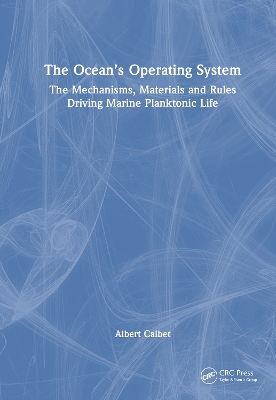
The Ocean’s Operating System is a mechanism-first guide to how the sea actually works. Instead of lists of species and case studies, it teaches the rules—light, viscosity, turbulence, temperature, oxygen, pressure, and elemental budgets—and the devices organisms use to play by them: filters and houses, pellets and gels, pigments and transporters, migrations and dormancy. You will learn to read edges and thin layers (microlayer, thermoclines, DCMs, OMZ rims, submesoscale fronts), to see how carbon is routed—recycled aloft or exported at depth—by mineral ballast, gelatinous packaging, and the active pump of diel migrants. Climate change and acidification appear where they truly act (on viscosity, oxygen margins, saturation horizons), while molecular and genomic ecology grounds traits in genes, transcripts, proteins, and metabolites. Throughout, the emphasis is on rate coupling, clean inference, and portable field signatures—size spectra, pellet fall speeds, acoustic and optical cues—you can test at sea. Written in clear, quantitative prose with only the math the argument needs, this book equips researchers, advanced students, modelers, and managers to move from a handful of measurements (light profiles, microstructure, T–S–O₂, simple optics and chemistry) to community strategies, carbon routing, and flux. If you want a transferable toolkit—one you can carry from shelf to gyre, from polar ice to urban plumes—to predict “who will win, what will happen, and why,” this is your field manual for reading, and using, the code that runs the ocean.
| Weight | 0.4611624 kg |
|---|---|
| Author | |
| Editor | |
| Photographer | |
| Format | |
| Illustrators | |
| Publisher |
Only logged in customers who have purchased this product may leave a review.

Paperback
£35.00
Paperback
Original price was: £15.00.£10.00Current price is: £10.00.In Stock
Paperback
£17.00
Paperback
£17.00
Hardback
Original price was: £83.00.£76.95Current price is: £76.95.
Paperback
£78.00
Reviews
There are no reviews yet.