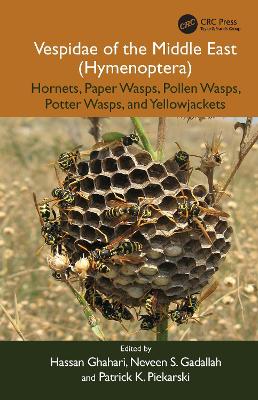

Vespidae of the Middle East (Hymenoptera): Hornets, Paper Wasps, Pollen Wasps, Potter Wasps, Yellowjackets

£150.00

Available for Pre-order. Due June 2026.

Vespidae of the Middle East (Hymenoptera): Hornets, Paper Wasps, Pollen Wasps, Potter Wasps, Yellowjackets Editors: Neveen S. Gadallah, Hassan Ghahari, Patrick K. Piekarski Format: Hardback First Published: Published By: Taylor & Francis Ltd
string(3) "264"
Pages: 264 Illustrations and other contents: 5 Line drawings, color; 2 Line drawings, black and white; 47 Halftones, color; 1 Halftones, black and white; 52 Illustrations, color; 3 Illustrations, black and white Language: English ISBN: 9781041241461 Categories: , , , , , , , , , , , , , , , ,

The cosmopolitan family Vespidae (Hymenoptera: Vespoidea) comprises approximately 5,000 described species worldwide, traditionally classified into six subfamilies: Stenogastrinae, Eumeninae s.l., Euparagiinae, Masarinae, Polistinae, and Vespinae. Among vespid wasps, social behavior ranges from solitary nesting to highly eusocial societies that function as superorganisms. Vespid wasps play vital roles in terrestrial ecosystems and are recognized as efficient biological control agents, preying on caterpillars and other insects, including many agricultural pests. Additionally, by occupying top positions in terrestrial arthropod food webs and visiting flowers for nectar, they contribute to the pollination of fruit and vegetable crops. Some vespid species have become invasive pests, and/or are feared for their painful stings, which can be fatal to individuals allergic to their venom. This book presents the first comprehensive treatment of the Vespidae of the Middle East, offering detailed information on 716 valid species and subspecies across 69 genera in four subfamilies: Eumeninae, Masarinae, Polistinae, and Vespinae. It provides complete taxonomic treatment of all subfamilies known from the region, along with insights into their general biology, ecology, and geographic distribution. The book also includes discussions on morphology, identification keys to genera, economic importance, diagnostic characters of each group, and their affinities with related groups. An extensive bibliography of over 800 references supports further study and, whenever possible, the information has been updated to reflect the most current knowledge. As the definitive guide to the Vespidae of the Middle East, this book serves as a valuable resource for researchers studying wasps worldwide.

Weight0.6239256 kg
Author
Editor
Photographer
Format

Illustrators
Publisher

Reviews

There are no reviews yet.

Only logged in customers who have purchased this product may leave a review.

Author Biography

Hassan Ghahari is currently working as a Professor of Entomology (Insect Systematics, and Biological control) at Plant Protection Department, Yadegar-e-Imam Khomeini (RAH) Shahre Rey Branch, Islamic Azad University, Tehran, Iran. He received his B.S. degree in Plant Protection from Urmia University, M.Sc. in Agricultural Entomology from Isfahan University of Technology, and Ph.D. in Agricultural Entomology from Tehran Islamic Azad University. He is an accomplished scholar and expert in the field of insect systematics and biological control. He teaches several courses in Entomology and has guided many M.Sc. and Ph.D. students. He has received several research grants from Islamic Azad University as well as many Iranian prestigious awards and coveted honors. Dr. Ghahari has authored or co-authored more than 250 scientific papers in peer-reviewed international journals together with several authorized entomologists from different countries. He has served as editor for several books and co-authored over 150 book chapters for various reputable publishers (e.g., CABI, Elsevier, Springer, Magnolia Press, CRC Press, and IAU Press) on various topics related to insect systematics and biological control. He also is a member of the editorial board of many agricultural scientific journals in different countries. Neveen Samy Gadallah is Professor of insect taxonomy in the Entomology Department, Faculty of Science, Cairo University, Egypt. She earned her B.S. in Entomology, as well as her M.Sc. and Ph.D. degrees in Insect Taxonomy, from Cairo University. Her research focuses on insect biodiversity and taxonomy, particularly within the order Hymenoptera in the Middle East. She has authored and co-authored over 150 scientific papers, monographs, and book chapters published in peer-reviewed international journals and publishers, collaborating with numerous hymenopteran taxonomists worldwide. She has also served as an associate editor in many scientific journals. Patrick Piekarski is a postdoctoral researcher in the Laboratory of Social Evolution and Behavior at The Rockefeller University, USA. He holds a B.Sc. (Honors) in Zoology from the University of Calgary, M.Sc. in Biology from the University of Central Florida, and Ph.D. in Biology from The Rockefeller University. His research spans Vespidae taxonomy and phylogenetics, animal social behavior, particularly in wasps and ants, as well as molecular biology and behavioral genetics. Dr. Piekarski has received several awards and fellowships, including the prestigious NSERC Canada Graduate Scholarship. He has authored or co-authored seven peer-reviewed journal articles, including a landmark study reconstructing the phylogeny of the Vespidae family. He has presented his work at major scientific conferences and has been a member of several professional societies, including the American Genetics Association, the International Union for the Study of Social Insects, the Entomological Society of America, and the International Society of Hymenopterists. Driven by a fascination with insect societies, Dr. Piekarski investigates how genetics and the social environment shape behavior and morphology.