


We ship worldwide - see checkout for options

Exceptional customer service trusted by 100's
£159.95
We ship worldwide - see checkout for options
Exceptional customer service trusted by 100's
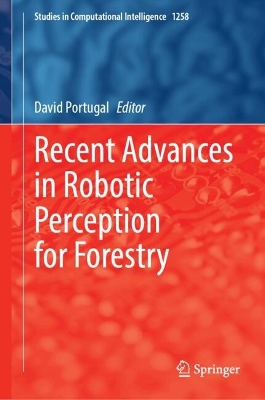
This book addresses all aspects of artificial perception in forest environments, including localization, mapping, traversability analysis, semantic segmentation, metric-semantic mapping, scene understanding, and multi-robot architectures. Forests are among the most complex and challenging environments for robotic perception. They are dynamic, unstructured, and unpredictable, with variable weather and lighting conditions, dense canopy, rough terrain, and unreliable GNSS signals. These conditions have delayed the large-scale introduction of autonomous systems into forestry, despite the clear potential for robotics to transform tasks such as landscape maintenance, wildfire prevention, tree health monitoring, and precision harvesting. Recent Advances in Robotic Perception for Forestry explores innovative developments that aim to bridge this gap. It addresses advances in sensing, perception, and learning and how they enable autonomous ground, aerial, and manipulator systems to operate effectively in forested landscapes. Forestry robotics is an emerging field at the intersection of automation, AI, and sustainable land management. Tasks that are often dangerous or physically demanding for humans can, in many cases, be reliably perceived and executed by robots. This book discusses current technologies, ongoing research, and future directions in areas such as multi-sensor fusion, robust navigation, environmental monitoring, and precision forestry. Featuring contributions from leading researchers, this book offers both foundational insights and practical solutions. It is designed for academics, engineers, and industry professionals interested in applying robotic perception to real-world forestry problems, pushing the frontier of sustainable automation in one of the most demanding domains for robotics.
| Weight | 0.5 kg |
|---|---|
| Author | |
| Editor | |
| Photographer | |
| Format | |
| Illustrators | |
| Publisher |
Only logged in customers who have purchased this product may leave a review.

Hardback
£25.00

Hardback
£14.95
Hardback
Original price was: £75.00.£55.00Current price is: £55.00.

Paperback
£6.75



Reviews
There are no reviews yet.