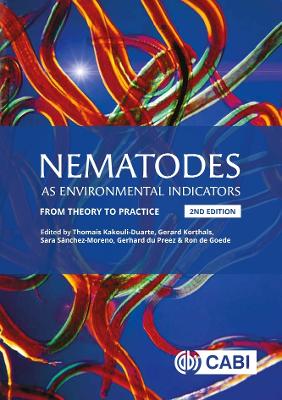
Nematodes are the most widespread multicellular animals in nature and analysis of nematodes in terrestrial, freshwater and marine environments, as well as their role and function in ecosystems, can be used for environmental biomonitoring. This new edition addresses pertinent environmental issues, for example climate change and work across large spatial scales, and how these are reflected onto nematode communities. It also discusses how nematode communities may be utilised to gain relevant knowledge to mitigate the effects of these threats. Other new topics include: -Nematodes as indicators of sustainable agriculture -Nematodes in extreme environments -Novel nematode identification approaches using image analysis and machine learning -Nematodes and environmental policy -Environmental nematology education -Recommended protocols for nematode sampling and subsequent analyses. This book provides a hands-on approach suitable for readers who wish to embark and carry out practical work in environmental nematology for the first time, and for more experienced researchers. It is suitable for nematologists, soil and aquatic ecologists, agronomists and environmental scientists.
Author Biography
Thomais Kakouli-Duarte (Edited By) Thomais Kakouli-Duarte holds a BSc (Hons) in Crop Production from the University of Western Macedonia in Greece and an MSc and a PhD from the University of Reading, UK, under the supervision of the late Nigel Hague. She is currently a biosciences and ecology lecturer on the Carlow campus of the South East Technological University (SETU) in Ireland. In SETU she leads the Molecular Ecology and Nematode Research Group and she is also the co-Director of enviroCORE, SETU's centre of research and enterprise in bio-environmental technologies. Her current research is transdisciplinary, investigating how nematodes respond to novel bio-based fertilisers in the part-funded Interreg-NWE ReNu2Cycle project, how telecommunications principles can be applied to model molecular interactions between nematodes and bacteria and how humanities, plant science, digital education and environmental nematology can work together for soil health. Gerard W Korthals (Edited By) Gerard Korthals is an expert on soil biology, soil health, tropical ecology, ecotoxicology and nematology. He started his career as a biologist at the Free University in Amsterdam. He performed his PhD (Pollutant induced changes in terrestrial nematode communities) at the Agricultural University of Wageningen under the supervision of Tom Bongers. Since 1999 he is a senior scientist for Wageningen Plant Research (WUR). Most important themes focus on the development of durable agricultural systems, soil health, biodiversity, and sustainable land use. His special interest lies within soil ecology and soil health, focusing on how the whole soil food web, with a special focus on nematode communities (plant parasitic end non plant parasitic), may change due to management, disturbance, climate, set-aside and management practices, in relation to plants (natural vegetation and crop productivity). Sara Sánchez Moreno (Edited By) Sara Sanchez Moreno has a Degree in Biology and PhD in soil nematode ecology. She started studying soil nematodes as a PhD student, when she worked on the effects of heavy metals on the soil nematode community. She completed a post-doc in the Department of Nematology at the University of California - Davis, where she worked in the soil ecology of agricultural systems, and specialized in the assessment of soil health. She has been a tenure scientist at the National Institute of Agricultural and Food Research and Technology and now develops her research on natural and agricultural systems at the Spanish National Museum of Natural Sciences. Gerhard du Preez (Edited By) Gerhard du Preez is an Associate Professor in Agricultural Sciences at the North-West University (Potchefstroom Campus, South Africa). He holds a PhD from the same institution, where he studied the impact of irrigation water quality on soil health using nematodes as bioindicators. He leads and collaborates on interdisciplinary projects exploring soil biodiversity, nutrient cycling, carbon dynamics, and the ecological impacts of diverse agricultural systems on soil health. He teaches undergraduate and postgraduate modules in agroecology, soil health, and sustainable agriculture, and plays an active role in developing research infrastructure and training platforms that promote climate-smart, ecologically sound farming practices. Ron de Goede (Edited By) Ron de Goede graduated as a soil biologist from the Free University (VU) of Amsterdam in 1986 and started a PhD trajectory in the Laboratory of Nematology at Wageningen University. He worked under the supervision of Tom Bongers on studying the response of nematode communities to environmental conditions and perturbations. His current research focuses on soil ecology and biology in general, but still with a focus on nematode community structure. Besides teaching at Wageningen University, he is a visiting professor at Gent University, coordinating the course Soil biodiversity and nematodes as bioindicators for soil health, which is part of the international MSc ImaNema.






Reviews
There are no reviews yet.