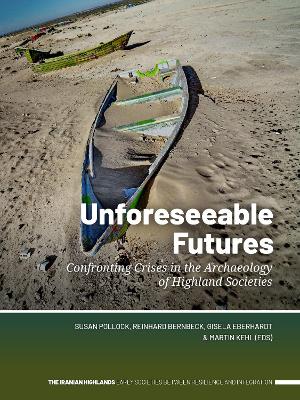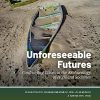

Unforeseeable Futures: Confronting Crises in the Archaeology of Highland Societies

£95.00

Available for Pre-order. Due October 2026.

Unforeseeable Futures: Confronting Crises in the Archaeology of Highland Societies Editors: Reinhardt Bernbeck, Gisela Eberhardt, Martin Kehl, Susan Pollock Format: Hardback First Published: Published By: Sidestone Press
string(3) "220"
Pages: 220 Illustrations and other contents: 63fc / 19bw Language: English ISBN: 9789464271720 Categories: ,

Despite their apparent ubiquity today, archaeologists have seldom focused explicitly on crises. The authors in this book take up the challenge of doing so, drawing on archaeological cases from a wide temporal and spatial range. In addition to identifying crises, the contributions search for the factors that underlie them. These range from climate to disease, environmental destruction, sudden natural events such as volcanic eruptions, and intra- or intersocietal conflicts. Factors are often intertwined in complex ways that lead to emergent properties and that can neither be attributable solely to anthropogenic nor to natural causes. Coping with crises include rearrangements of ways of life, such as increasing or decreasing mobility, the use of alternative (‘second-choice’) food sources, recourse to intensified or newly developed rituals, demise of old institutions and/or the building of new ones, and small-scale acts of subversion. This book is the fifth volume of a series published by the German-Iranian research cooperation “The Iranian Highlands: Resiliences and Integration in Premodern Societies”. The goal of the research project is to shine a new light on communities and societies that populated the Iranian highlands and their more or less successful strategies to cope with the many vagaries, the constant changes and risks of their natural and humanly shaped environments.

Weight0.68208 kg
Author
Editor
Photographer
Format

Illustrators
Publisher

Reviews

There are no reviews yet.

Only logged in customers who have purchased this product may leave a review.
Author Biography

Susan Pollock held positions as professor of Western Asian Archaeology at the Freie Universität Berlin and professor of Anthropology at Binghamton University. She has long-standing research interests in village, early state, and urban societies in Western Asia and has conducted fieldwork in Iraq, Iran, Turkey, and Turkmenistan. She also researches more recent periods and has worked on sites of the 20th century in and around Berlin. Her research draws on feminist and political economic approaches to the study of the past, with specific attention to processes of subjectivation and the place of commensality in social life. She is the author of Ancient Mesopotamia: The Eden that Never Was (1999), editor of Between Feasts and Daily Meals. Toward an Archaeology of Commensal Spaces (2012), and co-editor (with Reinhard Bernbeck and Kamyar Abdi, 2010) of The 2003 Excavations at Tol-e Baši, Iran: Social Life in a Neolithic Village and Looking Closely. Excavations at Monjukli Depe, Turkmenistan, 2010 – 2014, Volume I (with Reinhard Bernbeck and Birgül Ögüt, 2019). Reinhard Bernbeck is Professor i.R. of Western Asian archaeology at the Freie Universität Berlin and professor emeritus of Anthropology at Binghamton University. His interests include the prehistory of Iran, archaeological manifestations of repression, exploitation and suffering, and ideological dimensions of archaeological practice. He has carried out fieldwork in Iran, Iraq, Syria, Jordan, Turkey, and Turkmenistan. He has also investigated several prisoner-of-war and forced labor camps from the 20th century in Germany. He is the author of Materielle Spuren des nationalsozialistischen Terrors (2017), co-editor (with Randall H. McGuire) of Ideologies in Archaeology (2011), Subjects and Narratives in Archaeology (with Ruth van Dyke, 2015), Between Memory Sites and Memory Networks (with Kerstin Hofmann and Ulrike Sommer, 2017), and Containers of Change (with Olivier Nieuwenhuyse and Koen Berghuijs, 2023). Gisela Eberhardt is a project manager for the joint research project “The Iranian Highlands. Resiliences and Integration in Premodern Societies” at Freie Universität Berlin and an editor in the editorial department at the German Archaeological Institute’s (DAI) head office. She holds a PhD in archaeology from Humboldt-Universität zu Berlin and was one of the managing editors of Edition Topoi. She is the author of the book Deutsche Ausgrabung im ‘langen’ 19. Jahrhundert. Eine problemorientierte Untersuchung zur archäologischen Praxis (2011) and of the forthcoming chapter “From Deep Holes to the Bigger Picture. A History of Methods in Archaeological Excavation” in The Oxford Handbook of the History of Archaeology as well as co-editor (with Fabian Link) of Historiographical Approaches to Past Archaeological Research (2015). Martin Kehl is Professor of Physical Geography at the University of Koblenz and studies the significance of climate and humans for landscape evolution as well as the effects of environmental changes on pre-modern societies. He investigates sedimentary archives of past environmental change and human adaptation including soils, loess, lake sediments and anthropogenic deposits. His research focuses on the Late Quaternary and Iran. He is the author of Quaternary loesses, loess-like sediments, soils and climate change in Iran (2010) and co-editor of Loess records of environmental change (2020), Inside-outside. Integrating cave and open-air archives (2018) and Loess, soils and climate change in Iran and vicinity (2017). Results of his research on the Quaternary of Iran are also published in a large number of co-authored peer-reviewed papers.