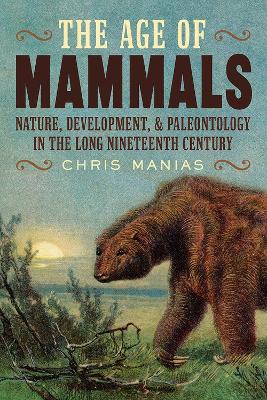
When people today hear “paleontology,” they immediately think of dinosaurs. But for much of the history of the discipline, dramatic demonstrations of the history of life focused on the developmental history of mammals. The Age of Mammals examines how nineteenth-century scholars, writers, artists, and public audiences understood the animals they regarded as being at the summit of life. For them, mammals were crucial for understanding the formation (and possibly the future) of the natural world. Yet, as Chris Manias reveals, this combined with more troubling notions: that seemingly promising creatures had been swept aside in the “struggle for life,” or that modern biodiversity was impoverished compared to previous eras. Why some prehistoric creatures, such as the saber-toothed cat and ground sloth, had become extinct, while others seemed to have been the ancestors of familiar animals like elephants and horses, was a question loaded with cultural assumptions, ambiguity, and trepidation. How humans related to deep developmental processes, and whether “the Age of Man” was qualitatively different from the Age of Mammals, led to reflections on humanity’s place within the natural world. With this book, Manias considers the cultural resonance of mammal paleontology from an international perspective – how reconstructions of the deep past of fossil mammals across the world conditioned new understandings of nature and the current environment.
The Age of Mammals provides a fresh perspective on the history of paleontology, the cultural and scientific significance of mammals, and the implications of colonialism for the scientific enterprise in the long 19th century. * American Historical Review * a work that is not only an impressive scholarship, but also enjoyable to read... Manias’s work is a valuable contribution to the history of evolution and paleontology, to animal studies, and to anyone who has wandered through a museum exhibit on the history of life. * Animal History * The Age of Mammals is not only an interesting read, full of personal vignettes and stories of extinct mammals that entered human conscious as monstrous ancient beasts, but also a meticulous account of the formation of the field of paleontology in the long nineteenth century. * Isis * This book is certainly fascinating. * Choice Reviews * Manias’ work really excels in reclaiming and redescribing the practice of palaeontology in the nineteenth century in all of its expansionist, political, and cultural complexity. * Palaeontologia Electronica * Dinosaurs get all the attention, from museum visitors as well as historians. But with this brilliant new book, Chris Manias sets the record straight and shows that mammalian paleontology is where it’s at. Deeply researched and beautifully written, The Age of Mammals is brimming with fresh insights and novel interpretations. Scientists invested mammals with particular significance because their evolution presaged the development of our own species. This makes them an ideal site to examine how widespread ideas about evolutionary progress and biological hierarchy emerged from the entanglement between science and empire. This book is also a pleasure to read, taking readers on a wide-ranging tour through the history of the earth sciences that spans several centuries and covers the entire globe. -- Lukas Rieppel, author of Assembling the Dinosaur: Fossil Hunters, Tycoons, and the Making of a Spectacle Age of Mammals is a wide-ranging, fascinating, and definitive account of how ancient mammals were discovered and given meaning through heated debates about lost life on earth. Stories of fossils and their finders, from famed scientists to erased local and Indigenous experts, and the sites in which fossils were give meanings, from fieldwork to exhibitions, are deftly woven together to show that the knowledge and world making of paleontology were tied to global fieldwork, capitalist resource extraction, museum collections, and ideas about the rightful place of humans in the modern world. This book establishes Chris Manias as a significant scholar of the history of life sciences and will be invaluable to anyone interested in the legacies of how life on earth has been imagined. -- Sadiah Qureshi, University of Birmingham An extremely valuable contribution to our understanding of nineteenth- and early twentieth-century paleontology. * H-Net Reviews * The Age of Mammals . . . is easy to recommend. It is not just a corrective to the traditional focus on dinosaurs: it is a major historical accomplishment in its own right. It deserves a wide and enthusiastic readership. * Quarterly Review of Biology * In addition to filling a major lacuna in our history of nineteenth-century paleontology, then, Manias also provides an argument that understanding science’s history requires a complex weaving of themes across intellectual, economic, social and colonial perspectives. It is an impressive and often arresting achievement. * British Journal for the History of Science *










Reviews
There are no reviews yet.