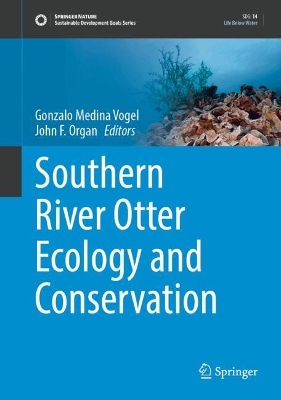

Southern River Otter Ecology and Conservation

£179.95

Available for Pre-order. Due August 2026.

Southern River Otter Ecology and Conservation Editors: Gonzalo Medina-Vogel, John F. Organ Format: Hardback First Published: Published By: Springer Nature Switzerland AG
string(3) "340"
Pages: 340 Illustrations and other contents: X, 340 p. Language: English ISBN: 9783032295040 Categories: , , , , , ,

The main factor contributing to the decline in distribution of the Endangered Southern River Otter (Lontra provocax) in freshwater ecosystems in Patagonia over the last 200 years is land use change, since riparian forests were converted into agricultural land, agricultural lands into exotic forest plantations, and recently, agricultural lands and exotic forest plantation into recreational and residential properties. These changes result in extended loss of riparian forest and wetlands along the coastal mountain range and central flatlands of the eastern section of continental Chile. Parallel to this, the developing Chilean mining and pulp industry and growing need of electricity and water result in the overexploitation of rivers and streams, mainly below 400 m.a.s.l. Poaching in Argentina and Chile was an important factor only until end of the 1980s. “Southern River Otter Ecology and Conservation” presents the results of more than 40 years of continuous field research in search of evidence to identify the environmental factors that are dragging the Southern river otter to extinction, including logistical difficulties of fieldwork related to the species, and information about  its ecology, societal perceptions, human landscape transformation. A proposal for conservation of this species at a  continental scale, that is, beyond the current network of protected areas, as the only strategy that will allow in situ  conservation of the species in the future is offered. Within this conservation strategy, the weaknesses and risks of the neoliberal conservation model prevailing in the region are exposed and discussed. In “Southern River Otter Ecology and Conservation” animal ecology is mixed with geography, the ecology of invasive species and infectious diseases, the effect of climate change, along with social aspects and economic policies, with the aim of a better understanding of the problem behind the extinction and the challenge of Southern River Otter conservation.

Weight0.7957312 kg
Author
Editor
Photographer
Format

Illustrators
Publisher

Reviews

There are no reviews yet.

Only logged in customers who have purchased this product may leave a review.
Author Biography

Gonzalo Medina-Vogel holds a Ph.D. in Wildlife Ecology, Lincoln University, New Zealand (1999). Veterinarian, Austral University of Chile (1989). Founding Director of the School of Veterinary Medicine at Andres Bello University. Founding Director of the Ph.D. program in Conservation Medicine at Andres Bello University. Member of the Aquatic Mammals Expert Committee of the Fisheries Subsecretariat of the Ministry of Economy. Research in the ecology and conservation of aquatic and terrestrial carnivores, cetaceans, seabirds, bats, human dimensions in conservation, and ecological restoration. Part of commissions in designing conservation policies and selecting priority areas for conservation. Principal investigator for projects by the Frankfurt Zoological Society (1990-2001), Earthwatch Institute (2000-2006), Rufford Small Grant for Nature Conservation (2005-2008), Austral University of Chile, and Andres Bello University. National Fund for Science and Technology (Fondecyt), Environmental Protection Fund (FPA), Fisheries Research Fund (FIPA). Alternate researcher for the Chilean Antarctic Institute Fund (INACH). Since 1991 member of the IUCN/SSC Otter Specialist Group. Co-founder of the Latin American Association of Wildlife Veterinarians. Professor of courses in Conservation Medicine, Ecology of Infectious Diseases, Biological Invasions, and the Ecology and Conservation of Freshwater Ecosystems. From September 2013 to January 2017, assumed the Deanship of the Faculty of Ecology and Natural Resources at Andres Bello University and was appointed adjunct professor at the University of Massachusetts, United States. In 2017, Joined the Center for Sustainability Research (CIS) of the Faculty of Ecology and Natural Resources as a lead researcher and full professor at the University.  Since 2024, senior researcher of the One Health Institute at the same university. 2025 onwards IUCN Otter Specialist Group Co-coordinator for Lontra felina and Lontra provocax. Winner of the 2025 Otter Oscar by ISOF. John F. Organ is the former Chief of the U.S. Geological Survey Cooperative Fish and Wildlife Research Units. He was also Chief of Wildlife and Sport Fish Restoration for the Northeast Region of the U.S. Fish and Wildlife Service, and worked in the FWS's Ecological Services and National Wildlife Refuge programs during his 40 + year career. He is also an Adjunct Associate Professor of Wildlife Conservation at the University of Massachusetts, Amherst, Michigan State University, and Andres Bello University in Santiago, Chile. He received a Ph.D. in Wildlife and Fisheries Biology from the University of Massachusetts, Amherst. He is a certified Wildlife Biologist and Past President and Fellow of The Wildlife Society. He is also an Emeritus Member of the Boone and Crockett Club and a Senior Specialist in the Fulbright Scholar Program. He is a member of the IUCN Sustainable Use and Livelihoods Groups, and an instructor and Advisory Board member of the Conservation Leaders for Tomorrow Program. He is also a consultant to the Peru Forest Sector Initiative where he  assisted the Peruvian government in training biologists and developing wildlife regulations. He advises M.S. and Ph.D. students studying carnivores and human dimensions in Africa, Canada, Chile, and the U.S. and teaches graduate courses in Wildlife Management and Conservation and Human Dimensions of Wildlife Conservation. He has conducted research on a number of wildlife species including North American river otter, spotted-neck otter, Canada lynx, black bear, American beaver, North American mink, caribou, culpeo fox, chilla fox, and lesser grison.   He is a recipient of The Wildlife Society’s Aldo Leopold Memorial Award, the Wildlife Management Institute’s George Bird Grinnell Award, and the U.S. Department of the Interior’s Meritorious Service Award.