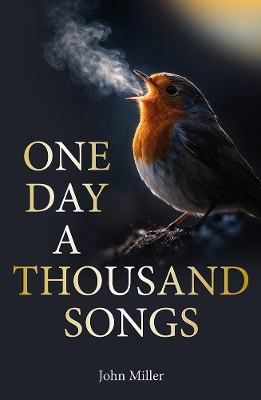
On 6 May last year, just before the first light of day, a robin sang the opening notes of the dawn chorus in John Miller’s Wiltshire garden at precisely 4.35am. For the rest of that day, until a tawny owl passed over at 9.23pm, each bird is briefly brought to life with John’s observations and fascinating backstories: their nests, their eggs, their battles, their triumphs. Sound recordist Alex Byng and photographer David White were with John throughout this red-letter day – which anyone can replicate in their own garden, using the Merlin bird ID app to help identify bird songs and confirm sightings.
John's beautiful new book, One Day, A Thousand Songs, follows a single spring day in his Wiltshire garden – from the first robin at 4.35am to a tawny owl at 9.23pm. Across that day, he brings each visiting bird briefly to life: their nests, eggs, rivalries, near-misses and small triumphs. It's intimate, factual and quietly dramatic – the wild world most people already have just outside their door. * Newbury Today * A local author's new book explores British garden birds through birdsong. The book also offers practical advice on managing gardens for wildlife, emphasising the importance of creating insect-friendly spaces. * The Reading Chronicle * These magnificent flying machines One Day A Thousand Songs John Miller Merlin Unwin Books £12 When it comes to public attention for Nature, it never ceases to amaze me how much birds dominate our airwaves. Together with the gift of flight, the second major avian USP is indubitably their ability to make music. In One Day a Thousand Songs, John Miller tells us he’s been so transfixed by birdsong that he has, as it were, arranged his entire domestic affairs to increase its depth and volume. His whole garden seems shaped to meet avian needs; between 4:35am and 9:23pm last year, he set out to demonstrate why he does it. He logged everything, from tiny goldcrests to 5ft-wingged red kites that sang or vocalised on his patch. Then, on these 40 species, he supplies further information about their lifestyles, but especially on how we can all work to encourage them. Mr Miller’s central message is not that we should cherish only birds, even less that we should single out their abilities to sing. Rather, he makes a powerful moral case that everything birds do and are derives from Nature as a whole. He argues for a bottom-up view of the living world that values what he calls ‘bio-abundance’, the maximum combined contribution of fungi, plants, trees, invertebrates and even soil-dwelling creatures that we neither know nor see. He asks us to understand birdsong in a radically new way, not as ethereal voices from above, but arising from the earth – in rotting vegetation, perhaps, or in the very soil itself. -- Mark Cocker * Country Life (Print, May 6) * This book is a delight. I shall return to it time and time again, for it is one of those books that grows new subtleties the more you yourself learn to pay attention to that to which your author - your mentor - is pointing. Anyone who loves observing, sympathising (however anthropomorphically!) with the daily drama - sometimes tragedy, sometimes comedy, and both are set to the wild music of birdsong - of the garden, the countryside, and its birds will be grateful for so meticulous and sensitive a chronicler and narrator. John Miller's writing more than once made me think of Gilbert White in its observation of the minute, easily missed, detail. His natural, easy style engages you from the first page, and there is much wisdom as well as love in these pages. I wished it longer. I would be proud to have written such a book, and it will have an honoured place on my shelves. -- Dr Charles Moseley, Cambridge Prof English






Reviews
There are no reviews yet.