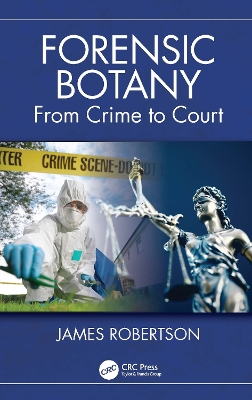

Forensic Botany: From Crime Scene to Court

£64.95

Available for Pre-order. Due August 2026.

Forensic Botany: From Crime Scene to Court Author: Format: Hardback First Published: Published By: Taylor & Francis Ltd
string(3) "336"
Pages: 336 Illustrations and other contents: 8 Tables, black and white; 3 Line drawings, color; 1 Line drawings, black and white; 55 Halftones, color; 18 Halftones, black and white; 58 Illustrations, color; 19 Illustrations, black and white Language: English ISBN: 9781032311852 Categories: , , , , ,

Forensic Botany: From Crime Scene to Court outlines a history of the discipline and field to provide current forensic operational context, real-world applications to cases, and how we arrived at this point. Written by a leading expert, the book presents forensic botany in a realistic and practical framework, offering a schema—a four-stage classification model—for how to manage botanical evidence in a contemporary case management context. Across twelve chapters, Robertson discusses aspects vital to forensic botany, from the central role of crime scene investigators and specialists (in ensuring that data is not mishandled or ignored) to how to handle a range of botanical materials in a triage environment so that they are properly preserved for detailed examination by suitable experts. This book shines a spotlight on the many approaches and forensic applications to plant science that are not traditionally considered, such as conservation, art fraud, and archaeology. In doing so, the coverage presents a novel and useful blueprint to employ a forensic approach in non-traditional areas. Forensic Botany will assist investigators and crime scene examiners in recognising the potential for forensic botanical evidence. It outlines a framework, for forensic professionals of varying levels of expertise to effectively manage botanical evidence and serves as an invaluable guide for those botany professionals undertaking forensic roles as subject matter experts.

Weight0.453 kg
Author

Editor
Photographer
Format

Illustrators
Publisher

Reviews

There are no reviews yet.

Only logged in customers who have purchased this product may leave a review.

Author Biography

James Robertson graduated from the University of Glasgow in 1972 with a BSc (Hons) in Agricultural Botany and in 1976 with a PhD in plant physiology. Following a short period as a postdoctoral researcher in London he entered the world of forensic science as a lecturer at the University of Strathclyde where he taught in the Master of Forensic Science from 1976 to 1985. James worked on a Royal Commission in South Australia in 1983 and in 1985 migrated to Australia in 1985 to work as a senior forensic scientist in Adelaide where one of his major roles was the examination of cannabis seizures and crops. He joined the Australian Federal Police (AFP) in 1989 as its first Director of forensic science. During the next 20 years he established the AFP forensic group as a world respected forensic organisation. Despite occupying a senior managerial role James always maintained his case work competency and his interest in all things academic! Hence, it was no surprise on his retirement from the AFP that he returned to an academic role as a Professorial Fellow at the University of Canberra (UC) and Director of the National Centre for Forensic Studies (NCFS). James ‘retired ‘(again) in 2019 but remains as a Professor Emeritus at UC. James has authored or co-authored over 200 academic papers and edited or co-edited several books on forensic science including books on fibres and hairs. He is Editor Emeritus of the Australian Journal of Forensic Sciences and a Life Member of the Australian Academy of Forensic Sciences (AAFS), and the Australian and New Zealand Forensic Science Society (ANZFSS) having served both organisations as either President or Vice President. James has chaired all of the major forensic advisory groups in Australia during his career. His contributions to forensic science have been formally recognised with the Public Service Medal (PSM), a Member of the Order of Australia (AM) and Doctor of the University of Canberra. James is a Fellow of the Royal Society of new South Wales (FRSN). James continues his active interest in, and passion for, the forensic aspects of trace evidence and criminalistics.