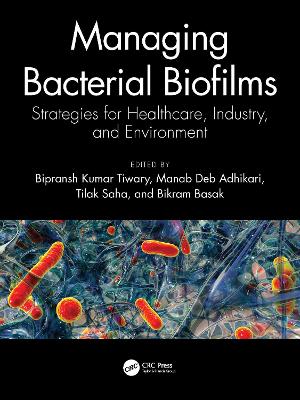
This authoritative book presents an advanced, interdisciplinary review on the biology, pathogenesis, and control of microbial biofilms across clinical, environmental, food, and industrial settings. The book focuses on the molecular mechanisms of quorum sensing and intercellular signaling. It also explores biofilm formation and resistance mechanisms in key bacterial pathogens, alongside chronic biofilm-mediated infections in wounds, sinuses, ocular tissues, and dental plaques. Furthermore, the chapters present device-associated infections and hospital-acquired biofilm complications, with an integrated review of innovative therapeutic options such as phage therapy, enzyme-based disruption, CRISPR-Cas antibiofilm tools, and smart nanomaterials. Beyond clinical implications, the book extends into biofilm dynamics in fresh produce spoilage, power plants, and the oil and gas industries. Toward the end, the book reviews the recent advancements in diagnostic imaging and AI-driven biofilm management. It is useful for students and researchers of microbiology, biotechnology, food, and environmental sciences. Key Features: Examines biofilms in human health, industrial settings, and energy systems Explores cutting-edge biofilm control strategies such as phage therapy, enzyme-based disruption, CRISPR-Cas systems, and nanotechnology-based solutions Highlights the growing concern of biofilm contamination on medical implants and hospital surfaces, with practical approaches for prevention and treatment Addresses biofilm roles in wastewater treatment, bioremediation, microplastic colonization, and environmental sustainability Introduces AI and machine learning for biofilm detection, prediction, and targeted disruption strategies in various environments
Author Biography
Bipransh Kumar Tiwary is an Assistant Professor at Department of Microbiology, North Bengal St. Xavier’s College, Rajganj, Jalpaiguri, West Bengal, India. He received his M.Sc degree in Microbiology. and Ph.D. degree in Biotechnology from the University of North Bengal, Siliguri, West Bengal. His main areas of research are medical microbiology, molecular biology, computer aided drug design, antibiotic resistance, antimicrobials, quorum sensing, and quorum quenching. He has published over 14 papers in scientific journals such as Plos one, RSC Advance, BMC complementary and alternative medicine and Letters in applied Microbiology and two book chapters. He is reviewer of several reputed journals. He has also published an edited book entitled “Microbes, Environment and Human Welfare” NOVA Science Publisher, USA. He has also published edited books entitled “Microbes, Environment and Human Welfare” NOVA Science Publisher, USA; Alternatives to Antibiotics: Recent Trends and Future Prospects. Springer Nature, Singapore, 2022; Recent Trends and The Future of Antimicrobial Agents, Part I & Part II. Bentham Science Publishers; 2023. He is a permanent member of the Microbiologists Society, India, Biotechnology Society of India and the Association of Microbiologists of India (AMI). Manab Deb Adhikari is currently working as an Assistant Professor in the Department of Biotechnology, University of North Bengal, Darjeeling, West Bengal, India. He holds a Ph.D. from IIT Guwahati and has over 15 years of experience in Nanobiotechnology and interdisciplinary chemistry-biology interface, with special interest in the development of diagnostics and therapeutics. His current research interests include nanobiotechnology, antibacterials, antimicrobial peptides, probiotics, and prebiotics. During 2014-2018, he served as a Research Professor in the Department of Chemical and Biological Engineering at Korea University, Seoul, South Korea. He has published more than 25 research works in leading peer-reviewed journals. He has contributed 15 book chapters in the area of applied microbiology and nanobiotechnology. He is awarded one patent. He has also published three co-edited books with Springer and Bentham Science Publishers. He has also served as a peer reviewer for several reputed scientific journals. He is serving as an editorial board member of the journal Scientific Reports. He is a permanent member of the Society for Biotechnologists (INDIA) and the Association of Microbiologists of India (AMI). Tilak Saha is Associate Professor at the Department of Zoology, University of North Bengal, Siliguri, West Bengal, India. He received his M.Sc degree in Zoology and Ph.D. degree in Biotechnology from the University of North Bengal. His main areas of research are medical microbiology, Immunology and host microbe interaction. He is associated with post graduate teaching since 2008. He has published research papers in scientific journals such as Journal of Ethnopharmacology, Future Journal of Pharmaceutical Sciences, International Journal of Systemic and Evolutionary Microbiology (Microbiology Society), New Journal of Chemistry (RSC), ACS Physical Chemistry Au, Current Science etc. He has also published edited books entitled “Microbes, Environment and Human Welfare” NOVA Science Publisher, USA; Alternatives to Antibiotics: Recent Trends and Future Prospects. Springer Nature, Singapore, 2022; Recent Trends and The Future of Antimicrobial Agents, Part I & Part II. Bentham Science Publishers; 2023. Bikram Basak is a fulltime Associate Professor at the Resource Development Research Institute, Hanyang University (HYU), South Korea. He earned his Ph.D. in Biotechnology in 2014 from the National Institute of Technology Durgapur, India, and is a recipient of the prestigious National Post-Doctoral Fellowship awarded by the Science and Engineering Research Board, Government of India. With over a decade of post-Ph.D. research and teaching experience in Environmental Microbiology and Biotechnology, Dr. Basak specialzes in bioremediation of organic pollutants and bioenergy production through fermentation and anaerobic co-digestion of waste biomass, sewage, and wastewater sludge. He specifically explores the microbiota structure, dynamics, and ecological functions within complex environmental microcosms, such as anaerobic digesters, membrane and electrode biofilms using state-of-the-art molecular microbiology including multi-metaomics. Dr. Basak has published about 50 articles in high-impact (Q1) international peer-reviewed journals with a citation h-index of 30, contributed to 12 book chapters, and holds two patents. He has published his works in reputed journals such as Trends in Microbiology, Renewable and Sustainable Energy Reviews, Chemical Engineering Journal, Journal of Hazardous Materials, Bioresource Technology, Journal of Cleaner Production, and many others. He has been awarded the excellent researcher title by Hanyang University in Dec 2022 and Dec 2023 for two of his high impact papers. His contributions have been recognized by the Biological Research Information Center of South Korea, and awarded as Hanbitsa (meaning people who make Korea shine) . Additionally, he is actively serving as reviewer for high impact (Q1) jounrals and as an Associate Editor for Frontiers in Biotechnology and Bioengineering, Frontiers in Biosciences-Elite, and editorial board member for Frontiers in Microbiology and Discover Biotechnology (Springer).




Reviews
There are no reviews yet.