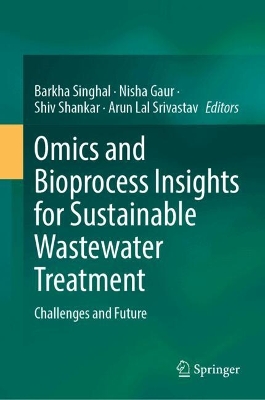
This contributed volume is a comprehensive guide that explores the transformative potential of omics technologies in the realm of wastewater treatment. This resource explores the integration of genomics, proteomics, metabolomics, and other omics approaches to enhance the efficiency, sustainability, and effectiveness of wastewater treatment processes. By examining the latest advancements and practical applications, the book addresses key challenges such as pollutant degradation, microbial community management, and process optimization. It also highlights future directions and innovative strategies for achieving sustainable wastewater management. Rich with case studies, industry insights, and future trends, this book equips researchers, industry professionals, and students with the knowledge and tools needed to navigate the complexities of modern wastewater treatment and drive innovation in the field.
Author Biography
Dr. Barkha Singhal is an Assistant Professor in the School of Biotechnology, Gautam Buddha University, Greater Noida. She has completed her Ph.D. at IIT Roorkee and has gained more than 16 years of teaching and research experience. Her research interest includes bioprocess optimization of both primary and secondary metabolites at shake flask and bioreactor. Currently, research is being pursued in the bioprocessing aspects of biosurfactant production from probiotic bacteria and plastic-degrading enzymes. She has guided more than 35 postgraduate students for their dissertation thesis and currently mentoring four Ph.D students. She has published various research papers in the International Journal of Repute. She has contributed several book chapters to a highly reputed publishing house. She has also written contemporary scientific articles in the biotechnology area in various Nationalized scientific magazines for effective scientific communication. Dr. Nisha Gaur is an Assistant Professor in Department of Biotechnology at the Gautam Buddha University, India. She has received her Ph. D from National Institute of Technology Warangal. She has done Post doctoral Research Associateship from Defence Research Laboratory, DRDO Tezpur. Her research interests lie in water quality monitoring, water treatment, soil health maintenance, phytoremediation, organic pollutant degradation and waste management. She is an editorial board member in the International Journal of Sustainable Energy. She has served as a reviewer in reputed journals. She has published 25 studies in reputed peer reviewed journals, 26 book chapters and 3 edited book to her name. She is also a member of Association of Microbiologist of India. Dr. Shiv Shankar is an Assistant Professor in the Department of Environmental Science, University School of Vocational Studies and Applied Sciences, Gautam Buddha University, Greater Noida, India. He obtained his Ph.D. in Environmental Science from Babasaheb Bhimrao Ambedkar University, Lucknow, in 2013. His research interests include environmental microbiology and biotechnology, microbial enzyme technology, wastewater bioremediation, sustainable waste management, bio-nano-synthesis, and nano-remediation. He has successfully completed a CST-UP funded Young Scientist research project on enzymatic deinking and ink decolorization. Currently, he focuses on sustainable waste management through the utilization of lignocellulosic wastes for cultivating high-value edible and medicinal fungi. Dr. Shankar is a recipient of the UGC Rajiv Gandhi National Fellowship and has published 23 research articles and 28 book chapters with reputed publishers including Springer, Elsevier, and Wiley. He actively contributes as a reviewer for scientific journals and is a member of several professional scientific societies. Dr Arun Lal Srivastav is working as Associate Professor at Chitkara University School of Engineering and Technology, Chitkara University, Himachal Pradesh, India. He received PhD from the Indian Institute of Technology (BHU), Varanasi in water treatment. He has done post-doctoral research at National Chung Hsing University, Taiwan. He is currently involved in the teaching of Environmental Science, Environmental Engineering, Disaster Management and Design Thinking to the undergraduate engineering students. His research interests include water quality surveillance, climate change, water treatment, river ecosystem, soil health maintenance, engineering education, phytoremediation and waste management. He has published >100 research papers in various prestigious journals (Elsevier, Springer, IWA, Taylor & Francis etc.) including some book chapters and conference publications. He has edited many books with Elsevier, Springer, NOVA, IGI global and Wiley. Additionally, he is also one of the series editors of Elsevier and Nova publisher on energy sustainability and e-waste management, respectively. He is also working on 04 Government sponsored projects (worth ~16 million INR) on phytoremediation, adsorption, capacity building, organic farming, leachate treatment, agro-waste management etc. He received the prestigious "Teachers Associateship for Research Excellence (TARE) Fellowship" followed by research grant from the Science and Engineering Research Board (SERB), Government of India in 2022. He has also filed 25 patents on multidisciplinary topics and 12out of which have been granted by the Government of India. He has also been recognised among the 2% worldwide scientists of Earth and Environmental Sciences jointly by Stanford University and Elsevier in the year 2023.




Reviews
There are no reviews yet.