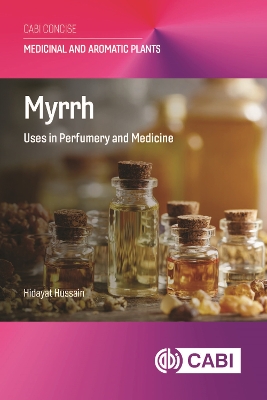
Myrrh: Uses in Perfumery and Medicine

£49.95

Available for Pre-order. Due February 2027.

Myrrh: Uses in Perfumery and Medicine Author: Editor: Professor Hartwig Schulz Format: Hardback First Published: Published By: CABI Publishing
string(2) "96"
Pages: 96 Language: English ISBN: 9781836993537 Categories: , , , , , , , , , ,

Myrrh is a solid exudate consisting of a mixture of volatile oils, gums and resins (oleo-gum-resins) which seeps from the bark of Commiphora trees. Myrrh has been used by mankind throughout history in incense, perfumes and cosmetics, and in both traditional and modern medicine. Phytochemical studies have shown that myrrh contains over 400 bioactive natural products, including terpenoids, resins and essential oils that exhibit diverse medicinal properties including anti-inflammatory, antioxidant, antimicrobial, analgesic and anti-cancer effects. Covering myrrh’s long history and multiple uses, this book also discusses the sustainable production and associated economy and trade of this prized commodity. It is of interest to researchers in medicinal plants, pharmacology, medicinal chemistry, botany and ecology, and herbal medicine practitioners.

Weight0.1971216 kg
Author

Editor

Photographer
Format

Illustrators
Publisher

Reviews

There are no reviews yet.

Only logged in customers who have purchased this product may leave a review.
Author Biography

Hidayat Hussain (Author) Hidayat Hussain received his PhD in Natural Product Chemistry in 2004. Following this he had positions as Postdoc (06-2004 to 09-2007) at the University of Paderborn, Germany and at the University of Maine, France (10-2007 to 09-2008). Dr. Hidayat was a group leader at the University of Paderborn, Germany, from 12-2008 to 07-2010. He worked as Associate Professor at Univ. of Nizwa in Oman (from 10-2011, to 10-2017). He was also a visiting professor at the Scripps Institution of Oceanography in San Diego, University of California, USA, from May to Sept. 2017. From 2018-2024 he was Humboldt guest Professor at the Leibniz Institute of Plant Biochemistry (IPB), Germany. From October 2024 he joined Bioengineering and Biosynthesis Technology Innovation Center, Qilu University of Technology China as visiting Professor. He has published over 400 papers in international journals, with a impact factor of over 1,200. He has published three books, over 10 patents and over 15 book chapters. He has also delivered over 60 lectures at international conferences held in the USA, Canada and Europe. He is also the chairman of the conference Academic Committee, which already organized two international conferences in China and other part of the world. He is the serving as Associate Editors and included editorial board of various International Journals. Furthermore, he has received over 13,000 citations, with h-index of 59. According to the Stanford University USA database, his name is included among the top two percent of most-cited scientists worldwide from 2020 to 2025. His research interests include natural product chemistry and the synthesis of bioactive molecules. In addition, his group also works on the biosynthesis of natural products. This includes the elucidation of new biosynthetic transformations and their application to the biocatalytic synthesis of natural products. Hartwig Schulz (Series Edited By) Hartwig Schulz (PhD) studied chemistry in Bonn and Kiel (Germany). After completing his studies, he carried out several years research in the field of human nutrition (vitamin E, phytosterins, plant lipids) at the university of Kiel, Germany. Then, as head of an analytical department he worked 10 years for one of the worldwide largest perfume and flavor manufacturers (Symrise). From 1996 to 2019, he was the director and professor of a research institute under the responsibility of the Federal Ministry of Agriculture in Germany. Hartwig Schulz is author of 259 scientific articles and book chapters and as the president of the "German Society for Quality Research (DGQ)" he was also engaged 8 years in food research on a national and international level. Since his retirement, he is working as a consultant, especially in the field of "medicinal and aromatic plants" and is also supporting various development aid projects on a voluntary basis.