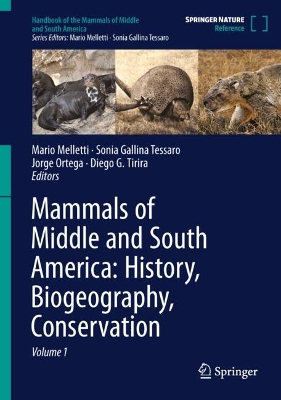
The first volume of the Handbook of the Mammals of Middle and South America presents a comprehensive synthesis of the historical, biogeographic, and conservation dimensions of Latin American mammalogy. This volume offers a rigorous, region-wide account of mammalian research across Middle and South America and the Caribbean region, with country-specific chapters documenting the historical development of mammalogy in over 20 countries. A country-by-country chronicle of the history of mammalian research. In-depth analyses of speciation, mammal taxonomy, and biogeography, with cutting-edge insights from phylogenomics. Critical discussions on climate change, invasive species, wildlife trafficking, and Anthropocene extinctions. Reviews of mammal conservation strategies, human-mammal interactions, and the shifting dynamics of mammal habitats and biodiversity hotspots. Explorations of paleontological transformations from the Middle Miocene to the Holocene, including the rise and fall of megafauna. With chapters on zoonotic diseases, conservation status, and the Linnaean shortfall in species discovery, this volume is an indispensable resource for academics, students, and professionals in mammalogy, ecology, and wildlife management. Rich in historical context and scientific rigor, it illuminates the past and present of mammal science in the region—and helps shape its future. A landmark reference for understanding the mammals of Latin America and the Caribbean region—where biodiversity meets biogeography, and history meets hope.
Author Biography
Mario Melletti (B.Sc., M.Sc., Ph.D.) is an Italian freelance wildlife biologist and member of the IUCN Wild Pig Specialist Group, Deer Specialist Group, and African Buffalo Initiative Group. He spent about two and a half years studying forest buffalo and lowland gorilla ecology and behavior in the Central African Republic and has conducted research and surveys on large African mammals in Burkina Faso, Uganda, Zambia, and Zimbabwe. Since 2010 he has edited Cambridge University Press volumes on large-mammal conservation—including Ecology, Evolution and Behaviour of Wild Cattle (2014), Ecology, Conservation and Management of Wild Pigs and Peccaries (2017), Bears of the World (2020), and Springer Nature titles such as Movement Ecology of Afrotropical Forest Mammals (2023), Tapirs of the World (2024), Deer of the World (2025), and Rhinos of the World (2025). He is the author of about 70 scientific publications. Sonia Gallina Tessaro (Ph.D.) is a co-founder of the Instituto de Ecología, A.C., located in Xalapa, Veracruz, Mexico, where she has been a researcher for more than 47 years, with bachelor’s, master’s and doctoral degrees from the Faculty of Sciences of the Universidad Nacional Autónoma de Mexico. She is currently a full researcher. Since the beginning, she has been dedicated to the generation of knowledge about wildlife, with long-term studies focused mainly on the communities of medium-sized mammals and especially on the ecology and behavior of deer, with the aim of their conservation. Most of her research has been conducted in various protected areas in Mexico. She is a member of the Mexican Academy of Sciences and the National System of Researchers, as well as coordinator of the North American Region of the IUCN-SSC-Deer Specialist Group. She is also a member of the EAGL DE MEXICO expert group on protected areas within the IUCN Green List. As a result of her research, she has published nearly 100 scientific articles, 83 book chapters, and 12 books, including most recently as editor and co-author of several chapters in the book Ecology and Conservation of Tropical Ungulates in Latin America, published by Springer Nature in 2019. Jorge Ortega (Ph.D.) is a Professor at the Departamento de Zoología, Instituto Politécnico Nacional in Mexico City. Holding a Ph.D. in Ecology from the Universidad Nacional Autonóma de México, his research interests are in eco-immunogenetics, behavioral ecology, and molecular biology of bats.He is the editor of several books, including 50 Years of Bat Research: Foundations and New Frontiers and Sociality in Bats, both published by Springer Nature. Diego G. Tirira (Ph.D.) is a Research Professor at the Universidad Yachay Tech, Urcuqui, Imbabura, Ecuador. He has been studying mammals and working for their conservation since 1990. He studied at the Pontificia Universidad Católica del Ecuador (PUCE), Universidad Internacional de Andalucia, and Universidad de Salamanca (Spain), with theses on the ecology of fish-eating bats, Antarctic seals, wildlife trafficking, and primate conservation. He has been invited to speak at several universities and congresses on all continents. He founded and was the first president of the Ecuadorian Association of Mammalogists (2010–2016) and has founded several groups of mammal specialists in Ecuador. He is a research associate at the Instituto Nacional de Biodiversidad (INABIO), in Ecuador, and at the Museo de Zoologia (QCAZ), at the PUCE. He has published 15 books on mastozoology, over 80 scientific papers, and a similar number of popular science articles.






Reviews
There are no reviews yet.