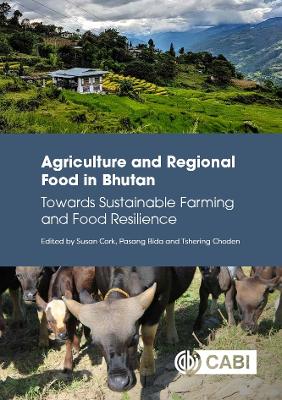

Agriculture and Regional Food in Bhutan: Towards Sustainable Farming and Food Resilience

£125.00

Available for Pre-order. Due August 2026.

Agriculture and Regional Food in Bhutan: Towards Sustainable Farming and Food Resilience Editors: Pasang Bida, Dr. Tshering Choden, Susan Cork Format: Hardback First Published: Published By: CABI Publishing
string(3) "240"
Pages: 240 Language: English ISBN: 9781800626119 Categories: ,

Bhutan is a small landlocked country in the Himalayas defined by a unique culture, high mountains, dense forests and fast flowing river carved valleys. An estimated 62% of the population live in rural areas and depend on subsistence agriculture and livestock farming for their livelihoods, although just 2.75% of the country’s land is suitable for cultivation. Farmers therefore face a unique set of constraints, including limited arable land, steep terrain, variable rainfall, poor soil fertility, climate change and evolving supply chains. Written by a collection of Bhutanese experts and edited by a team with a wide range of academic and practical expertise in animal health and the agriculture sector in the country, this book provides the first comprehensive account of agricultural development, food production systems and food preferences in Bhutan. It documents the history of agricultural development in Bhutan focusing on the period from the mid-1990s to the present, with reference to past traditions and current government initiatives. Additionally, through regionally specific case studies from the North, South, West, East and Central Bhutan, the book explores how agriculture and food cultures have evolved over time, linking scientific analysis with local knowledge and personal reflections. By highlighting innovative and sustainable production practices that can be replicated in comparable agro-climatic zones worldwide, this book offers both practical insights for researchers and policymakers and a rich cultural narrative for travellers and food enthusiasts seeking to understand Bhutan through its food. It is an essential reference for academics in agriculture, animal health and food systems, while also serving as an engaging guide for readers interested in the relationship between landscape, culture and cuisine in the Himalayas.

Weight0.5287968 kg
Author
Editor
Photographer
Format

Illustrators
Publisher

Reviews

There are no reviews yet.

Only logged in customers who have purchased this product may leave a review.
Author Biography

Susan Cork (Edited By) Dr Susan Catherine Cork is a professor at the University of Calgary, Faculty of Veterinary Medicine, Canada. Her research interests include veterinary public health, infectious diseases, animal health policy, and international development. Dr Cork has travelled extensively, including work as a volunteer veterinarian in South Asia, and she has over 25 years' experience working with Bhutanese colleagues on animal health related projects. She recently co-edited a Book on One Health Case Studies: Practical Applications of the Transdisciplinary Approach (2025), published by CABI and was the lead editor for a book on One Health and EcoHealth Case Studies, published in 2016 and 2024 respectively, She was also the lead editor for the third edition of the Veterinary Laboratory and Field Manual (2019) which was endorsed by the World Organization for Animal Health. The latter books were based on field experience gained working with colleagues in international development projects as well as from leading transdisciplinary teams alongside government agencies and NGOs in the United Kingdom, New Zealand, Canada, and Bhutan (South Asia). Dr Cork holds a veterinary degree and PhD from Massey University and a postgraduate Diploma in Public Policy from the University of Victoria, New Zealand. She is a member of the new CABI One Health initiative and has previously contributed to other CABI books including chapters on food safety, disease surveillance, animal health policy, and disease ecology. Dr Cork has published a wide range of peer reviewed papers, government reports, and general interest articles. Pasang Bida (Edited By) Pasang Bida works at the National Nucleus Pig Breeding Centre, Department of Livestock, Ministry of Agriculture and Livestock, Royal Government of Bhutan. The National Nucleus Pig Breeding Center (NNPBC), Yusipang, functions as a nucleus farm and maintains breeding stock to sustain pig breeding in the country. The Department of Livestock is the principal coordinator and apex body for livestock production in Bhutan and recently gave priority to increase both pig population and pork production in the country. Previously, Pasang was based at the National Centre for Animal Health (NCAH) and was the primary counterpart for Dr Susan Cork during her sabbatical project reviewing the veterinary diagnostic system in Bhutan in 2014. Pasang and Dr Cork travelled extensively across Bhutan during this time and gained much first-hand experience of the agriculture and food in different regions. Pasang, with her NCAH colleagues, is familiar with all regions of Bhutan and has developed an extensive network across rural communities in the North, South, East, West and Centre of the country. She also has connections and experience in other aspects of agriculture across Bhutan and within the Ministry. Tshering Choden (Edited By) Dr. Tshering Choden is a Senior Veterinary Officer at Bhutan's National Centre for Animal Health with expertise in virology, immunology, antimicrobial resistance (AMR), and diagnostics. She holds a master's in veterinary medical science (Virology and Immunology) from the University of Calgary and is currently a Fleming Fund Fellow in AMR Laboratory Animal Health at the Peter Doherty Institute, University of Melbourne. Dr. Choden has led national efforts in AMR surveillance, laboratory capacity building, and One Health programs and was Program Coordinator of Bhutan's National Accelerated Dog Population Management and Rabies Control Program (NADPM&RCP 2.0). A recipient of the prestigious Gustav Rosenberger Award 2023, she has represented Bhutan on multiple international platforms. Coming from a farm-based background and having lived closely with Bhutanese traditions, she has a deep, lived understanding of the country's agricultural and food heritage. Her exposure to diverse regional and international food habits has fostered a strong belief in the uniqueness of Bhutanese cuisine-a cultural tapestry that remains underrepresented globally. She is passionate about sharing this rich and evolving food culture through locally grounded insights and personal reflections.