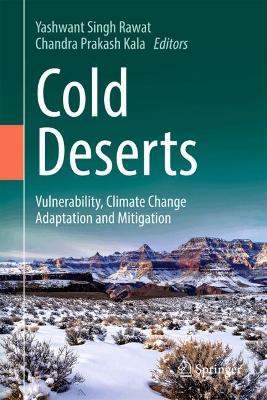
This contributed volume offers a variety of chapters that detail the state of cold deserts in the face of a changing climate. Chapters and cases included here address cold desert ecosystems, socio-economic issues in cold deserts and how they could be impacted by global change, and technologies for studying and minimizing climate change impacts. Topics covered include, but are not limited to: • Ecology, communities, utilization and management of high-altitude cold deserts’ bio-resources• Bioengineering, remote sensing and geographic information systems (GIS) • Agro-ecosystems, agroforestry, biodiversity and ecosystem services • Energy, communities, desertification and land degradation • Vulnerability, climate change adaptation and mitigation • Optimizing management strategies for sustainability
Author Biography
Yashwant Singh Rawat earned his MS and PhD in Forestry from HNB Garhwal University (a Central University), Uttarakhand, India. His doctoral research was conducted at the GB Pant National Institute of Himalayan Environment (NIHE), Uttarakhand, India, and its Himachal Regional Centre in Kullu, Himachal Pradesh—an autonomous institute under the Ministry of Environment, Forest and Climate Change, Government of India. Dr. Rawat has served in various academic and research capacities at the Uttaranchal (PG) College of Bio-medical Sciences, Dehradun (affiliated with HNB Garhwal University), NIHE, Nelson Mandela University (South Africa), the University of KwaZulu-Natal (South Africa), and the United Nations University (Japan). With over 19 years of professional experience following his PhD, Dr. Rawat has published extensively in international peer-reviewed journals, with more than 60 research papers and scholarly articles. He has contributed significantly to the academic community through editorial and peer-review service for leading journals and publishers such as Elsevier, Springer Nature, Frontiers, PLOS, Wiley, Taylor & Francis, and MDPI. Dr. Rawat is a recipient of several prestigious competitive fellowships and research support from India and abroad, including the CSIR Senior Research Fellowship (Government of India) and the United Nations University–Institute for the Advanced Study of Sustainability (UNU-IAS), Japan. He is currently a faculty member at the Federal Technical and Vocational Training Institute (TVTI), Addis Ababa, Ethiopia. His research interests include forestry, ecology, biodiversity and ecosystem services, environmental sustainability, sustainable energy, and resource-use. Chandra Prakash Kala earned his MS degree in Botany from HNB Garhwal University, and PhD in Forestry from the Forest Research Institute (Deemed University), Dehradun, India. He worked at the Wildlife Institute of India, GB Pant National Institute of Himalayan Environment, and the National Medicinal Plants Board with various capacities. His decade long research study on the ‘Valley of Flowers’ in India laid the foundation stone for tagging it in the list of World Heritage Sites by UNESCO. With over 32 years of professional experience, he has published >200 research papers and articles having over 8,700 citations. His area of interest is plant ecology, biodiversity conservation, natural resource management, and he has contributed significantly to policy initiatives, and capacity building. He is on the editorial and advisory board of many national and international scientific journals, including Journal of Ethnobiology and Ethnomedicine, PLoS Sustainability and Transformation, and PLoS Ecosystems. He is an elected member of the National Academy of Sciences in India (NASI), and also the recipient of prestigious ICFRE Award for Excellence in the Forest Conservation (Biodiversity and Ecology) in 2005. He has been a visiting scholar at the Pennsylvania State University, in the United States and the University of Ljubljana in Slovenia. At present, he is a faculty member at the Indian Institute of Forest Management, Bhopal, and he has been ranked among the top 2% of the world’s academicians/scientists by the Stanford University.




Reviews
There are no reviews yet.