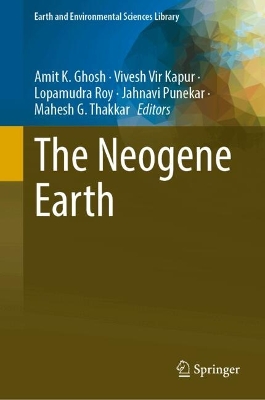
This book not only serves the researchers for future studies but also an important textbook for the graduate and post graduate students who are keen in pursuing their career in past climate research and climate modelling. There is an increased concern within the international scientific community regarding the global climatic variability in the present day Earth. This has simulated the scientists dealing with different aspects of climate research. In this context, the reconstruction of past climate is a useful tool for the prediction of future climatic changes because for better understanding of the future, a critical observation of the past is needed. Instrumental records of the climate are available for the last few centuries but not on a geological scale. Sediments deposited on the Earth archive different signatures in the form of different proxies namely geological features, fossils (both micro and macro), traces, geochemical parameters, etc. and these are useful to interpret past environment and climatic changes. In having the present scenario of global warming, it is highly important that we should interpret the past climatic events for better prediction of the future climate. If we consider the future climate projections is true, the climate of the Neogene Period can be one of the best analogues. During the Miocene Epoch of the Neogene Period, several major important climatic events took place, e.g. the Miocene Climatic Optimum (MCO), the beginning of the Arctic glaciations, the Messinian Salinity Crisis. During the youngest epoch of the Neogene, i.e. in the Pliocene, a global warming event also occurred, preceding the beginning of the Ice Age. All these events induced changes in the Neogene climate that impacted the biodiversity (both flora and fauna) of terrestrial and marine realms.
Author Biography
Dr. Amit K. Ghosh: Dr. Amit K. Ghosh worked as a Scientist of Birbal Sahni Institute of Palaeosciences (BSIP), Lucknow, India, in different capacities during 1994 to 2022 and presently working as an Emeritus Scientist of CSIR at BSIP. He also worked as a shipboard scientist of IODP Expedition and as a visiting scientist in Tuebingen, Germany. His prime research interests are focused on both terrestrial and marine Neogene and Mesozoic sediments. He has been the editor of different reputed journals and presently the advisory editor of Journal of Environmental Biology. He is a regular reviewer of Springer, Elsevier, Taylor and Francis, Cambridge University Press, and Frontier group of journals. He has contributed more than hundred research papers in peer reviewed journals of international repute along with number of field guide books. Dr. Vivesh Vir Kapur: Dr. Vivesh Vir Kapur obtained M.Sc. (Honours School) degree in Geology from Panjab University, Chandigarh, India, in the year 2002 and was awarded his Ph.D. degree in Earth Sciences in the year 2006 from Indian Institute of Technology (IIT) Roorkee (Uttarakhand, India). He has also gained work experience in the Geoscience Industry in India and UK. His research interests include Mesozoic-Cenozoic faunal remains in the context of origin, evolution, palaeoecology, palaeoenvironment, and biostratigraphy. He is also a fellow of the Geological Society of London, UK, and a council member of The Palaeontological Society of India. Dr. Lopamudra Roy: Dr. Lopamudra Roy’s prime research focus was to develop high resolution biostratigraphy from the deep-sea core of Andaman-Nicobar Basin using different micropalaeontological proxies along with geochemical analysis during her doctoral research at Birbal Sahni Institute of Palaeosciences (BSIP), Lucknow, India (2018 to 2023) under the auspices of DST-INSPIRE Fellowship. After obtaining Ph. D. degree in 2024, she pursued Post-Doctoral Research work at IIT Bombay, Mumbai, India and presently working as DST-INSPIRE Faculty at the Department of Earth Sciences, Indian Institute of Engineering Science and Technology (IIEST), Shibpur, West Bengal. She stood First in the M. Sc. Final Examination and is the recipient of Gold Medal awarded by the university. So far, she has published fourteen research papers in different journals of international repute and some research papers are in press or under review. Dr. Jahnavi Punekar: Presently, Dr. Jahnavi Punekar is working as an Associate Professor at Department of Earth Sciences, Indian Institute of Technology Bombay (IIT Bombay) since 2024. Earlier, she was an Assistant Professor of Indian Institute of Science Education and Research, Pune (IISER, Pune) during 2016–2017. She obtained Doctoral degree from Princeton University, NJ, USA, in 2015 and did M.Sc. from IIT Bombay in 2009. Her research area includes planktic and benthic foraminifera, mass extinctions, biostratigraphy, ocean acidification, and Deccan volcanism. She has published more than sixteen research articles in peer-reviewed journals. She is a regular reviewer of Springer and Elsevier journals. Prof. Mahesh G. Thakkar: Presently, Prof. Mahesh G. Thakkar is the Director of Birbal Sahni Institute of Palaeosciences (BSIP), Lucknow, India. Before joining BSIP in 2023 as the Director, he served Department of Earth and Environmental Science, KSKV Kachchh University as Professor and Head of the Department during 2008 to 2023. In the year 1999, he obtained Ph. D. degree in Geology from M. S. University of Baroda. His research interests are focused on neotectonic evolution, geomorphology, sedimentology, and palaeontology of the Neogene and quaternary sediments along with geoheritage. Working under his supervision, more than twenty Ph. D. students have been awarded Ph. D. degree. He has authored more than one hundred and twenty-five research papers in journals of international and national repute along with two books.







Reviews
There are no reviews yet.