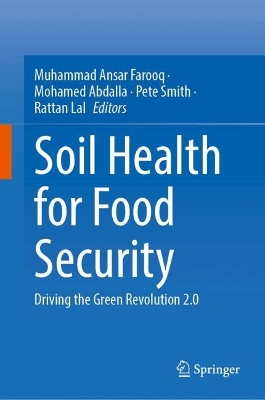
The original Green Revolution of the mid-20th century, often referred to as Green Revolution 1.0, was instrumental in drastically increasing agricultural productivity worldwide. This was achieved through the development and widespread adoption of high-yielding crop varieties, synthetic fertilizers and pesticide use. While this revolution contributed to food security for millions, it also triggered a range of environmental and socioeconomic challenges including soil degradation, biodiversity loss, and an increased dependency on chemical inputs. Considering the escalating challenges of the 21st century, such as climate change, growing populations, and the urgent need for sustainable food systems, it has become clear that agricultural practices must evolve to ensure long-term food security and environmental sustainability. The importance of this is recognized in the 2030 Agenda for Sustainable Development adopted by all United Nations, as SDG 2 Zero Hunger. This book, “Soil Health as the Catalyst for Green Revolution 2.0,” explores the potential of soil health as the cornerstone of a new agricultural paradigm that prioritizes sustainability, resilience, and environmental stewardship. By providing a comprehensive review of soil health principles, innovative agricultural technologies, and case studies from around the world, this book aims to inspire a new wave of agricultural innovation. Through the lens of soil health, we seek to reshape agricultural practices, fostering systems that are not only productive but also restorative to the planet.
Author Biography
Dr Muhammad Ansar Farooq is an Associate Professor of Environmental Sciences at the National University of Sciences and Technology (NUST) in Pakistan, with a distinguished academic career beginning in 2017 at the University of Agriculture, Faisalabad. He holds a Ph.D. in Natural Sciences from Universität Bielefeld, Germany, and has extensive experience in both academia and industry. From 2019 to 2021, he worked with Fauji Fertilizer Company, the largest fertilizer producer in Pakistan, where he gained valuable insights into the intersection of industry and academia.Dr. Farooq’s research primarily focuses on soil-plant-environment interactions, with expertise in synthetic fertilizers, soil pollution (including nano plastics, heavy metals, and salinity), and food security issues. He has contributed to numerous national and international research projects, funded by Pakistan Engineering Council, the Higher Education Commission of Pakistan, UNESCO, and the University of Aberdeen, UK.As a Fulbright Postdoctoral Fellow at the Lal Carbon Center, The Ohio State University, USA, Dr. Farooq’s current research is dedicated to exploring the climate-conscious analysis of nitrogenous fertilizers and their induced CO2 emissions. His work also seeks to quantify greenhouse gas emissions reductions through innovative environmental modeling techniques, with the goal of enhancing agricultural productivity while minimizing its environmental footprint. Dr. Farooq is passionate about advancing sustainable agricultural practices and addressing the urgent challenges of climate change. Dr Mohamed Abdalla is an Environmental Modeller at the University of Aberdeen, specializing in biogeochemical and crop modeling, greenhouse gas (GHG) emissions, and climate change mitigation and adaptation.His research focuses on applying advanced models such as DNDC, ECOSSE, DayCent, MiscanFor, and CERES to predict crop productivity, assess climate change impacts, and refine sustainable land management strategies across site, regional, and global scales. He applies these models to diverse ecosystems, including agricultural, grassland, and peatland systems, to enhance climate resilience and sustainability. Dr Pete Smith is Professor of Soils and Global Change at the Institute of Biological and Environmental Sciences at the University of Aberdeen (Scotland, UK) and Science Director of the Scottish Climate Change Centre of Expertise (ClimateXChange).His interests include climate change mitigation, soils, agriculture, food systems, ecosystem services modelling and nature-based solutions.He is a Fellow of the Royal Society of Biology, a Fellow of the Institute of Soil Scientists, a Fellow of the Royal Society of Edinburgh, a Foreign Fellow of the Indian National Science Academy, a Fellow of the European Science Academy, and a Fellow of the Royal Society (London). Dr Rattan Lal is a distinguished professor of Soil Science and Director of the Dr. Rattan Lal Carbon Management and Sequestration Center at The Ohio State University, USA.His work focuses on regenerative agriculture through which soil can help resolve global issues such as climate change, food security and water quality. His research diverged from the 1970s chemical fertilizer-intensive soil fertility approach to pioneering practices like no-till farming, cover crops, and agroforestry etc. These methods restore degraded soils, boost organic matter, and sequester atmospheric carbon to combat rising CO₂ levels.He was awarded the 2019 Japan Prize for the sustainable soil management for global food security and mitigation of climate change. On June 11, 2020, Professor Lal was named the recipient of the prestigious World Food Prize-2020.






Reviews
There are no reviews yet.