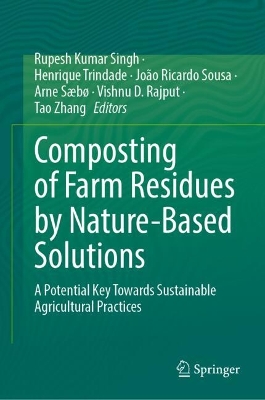
Sustainable management of organic residues dragged attention to develop model circular based economy in agriculture. Exponential increase in animal farming to meet the food security goals appeared as one of the major contributors of organic waste produce. Sustainable and effective transformation of this waste into fertilization resource, has become an urgent topic for environmental protection; while newly imposed regulations have been enforcing the researchers to obtain nature-based solutions (NBS). Major problems during composting of organic residues are Greenhouse gas emission (GHG), nutrient loss, ammonia volatilization, denitrification, nitrate leaching: thus, poor quality manures production. Thus, it is necessary to understand the mechanism during the composting process to develop sustainable composting practices by using NBS; to address multiple issues by a unique treatment method. The future of agriculture must change to adapt more sustainable approaches and recycling the organic residues to minimize the environmental impacts. Application of these transformed organic residues to soil to improve the soil natural properties and enrich the natural microbiome. The better crop performance and improved environmental health in a holistic approach is major objective. The past decade provided innovations and new technologies on the impact and use of organic composts in fields with tremendous outcomes. This book provides a wider and recent literature on evolution, multiple nature-based solutions, reduced environmental hazards and better management of organic waste produce towards transformation into usable manure for value added services. This compilation may provide a basis of further investigation of this potential key to achieve the sustainable management practices in modern agriculture.
Author Biography
Rupesh Kumar Singh is a passionate researcher with 10 years of post-PhD experience in diverse area of plant molecular biology, Agronomy, Vitiviniculture, plant physiology, Plant pathology, genetic engineering and modern genome editing technology, tissue culture, biochemistry, nanotechnology, biocontrol agents development and formulations, transcriptomics, proteomics, metabolomics. The research profile includes 3095 citations, H index-24 and 123 peer reviewed published scientific communications including 1 granted patent. Henrique Trindade holds PhD in Agrarian Sciences and coordinates the Animal Manures, Nutrient Cycles and Agriculture Sustainability group at Centre for the Research and Technology of Agro-Environmental and Biological Sciences – CITAB and is a Professor of Agriculture and Environment at the Department of Agronomy at UTAD (Portugal). He is also Vice director of CITAB center. Professor Trindade has coordinated several 42 R&D projects/contracts, 12 of which were European/international projects, on agro-food production and sustainability. Joao Ricardo Sousa is professor and experts in Soil and Environmental Sciences; Chemical and biochemical soil properties; Soil fertilization and plant nutrition; Soil pollution (N leaching, heavy metals, emergent pollutants liked solvents, detergents…) and assessment of environmental risks resulted of organic waste application like acidification, salinization; Soil remediation techniques (bio stimulation, composting, phytoremediation, bioaccumulation); Soil physical, chemical and biological quality indicators (soil respiration, soil biomass, N mineralization, decomposition, soil enzymes, earthworms tests; Soil fertilizers, pesticides behaviour; Biogeochemical cycles of carbon and nitrogen and main influence biotic (microorganisms, fauna) and abiotic (temperature, pH, moisture, aeration, chemical and biochemical quality organic matter) and assessment techniques in-situ and laboratory incubation experiments. Arne Sæbø graduated in hoticulture, with a PhD from University of Life Sciences in Norway. His research has been in Urban Greening and Urban Forestry. Focus areas have been on both growing conditions of urban vegetation and on Eco System Services from trees and shrubs. Soil amendments and use of compost as component in peat free growing media are important research areas the last years. Vishnu D. Rajput working as “Principal Scientist” and Head of `International Laboratory on Nanobiotechnology and Rhizosphere Bioengineering ' at Southern Federal University, Rostov-on-Don, Russia. In recent work, he is working on nano-bioengineering for soil rhizospheric microbes and enhanced remediation of contaminants using nanotechnology and metagenomics. Dr. Rajput is included in list of 2% world's potential scientists (2023, 2024, 2025) prepared by Stanford University. He is serving as Highly Qualified Specialist, Russian Federation, and obtained 2nd rank in Environmental and Earth Science. He has published 569 articles, H-index 58 with 13,375 citations as per Scopus database till September 2025. Tao Zhang is an Associate Professor at China Agricultural University, China. His academic background covers agricultural waste utilization and nutrients recovery. He is Associate Editor of BIOCHAR X. He is awarded the Scientific Chinese - Outstanding Young Scientist Award. He has published more than 100 papers in Chemical Engineering Journal, Water Research, Journal of Hazardous Materials, and so on (total citations = >5,500, H-index = 42, SCOPUS). Amongst, 14 ESI Highly Cited Paper, 5 ESI Hot Paper. He has application for 20 Chinese invention patents.





Reviews
There are no reviews yet.