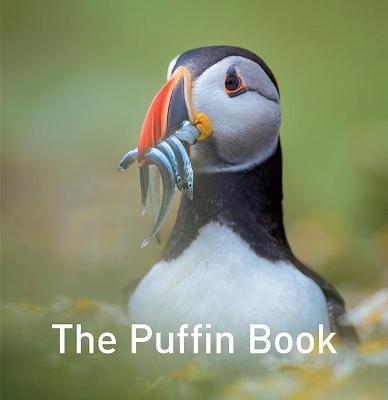
The Puffin Book is the latest in the compact, accessible Wildlife Book series, exploring our relationship with some of Britain's best-loved wild creatures. Sections include: • The Atlantic Puffin • Puffins Through the Seasons • Migration • Questions & Answers • Puffin in Myth, Legend and Art. Other titles in the series: - The Hare Book - The Red Squirrel Book - The Bee Book - The Fox Book - The Owl Book - The Robin Book - The Hedgehog Book - The Badger Book -- Publisher: Graffeg This is an interesting addition to a popular series of natural history books published by Graffeg. Others have dealt with the fox, hare, hedgehog and robin, to mention only a few. They all follow a similar book-production pattern in a 16cm square, hardback format, with the emphasis equally on the textual and photographic content. The author of The Puffin Book is Drew Buckley, an award-winning professional landscape and wildlife photographer whose work has appeared in many prestigious journals and featured on network television programmes. Based in Pembrokeshire, he is eminently qualified to compile this work, having spent many years observing these tenacious and unmistakable little birds at their breeding colonies on his doorstep on Skomer and Skokholm Islands. The book is basically a chronological study of the life of this bird over a period of 12 months. It includes an introduction to its family and its status, noting that it belongs to the auk family. The puffin’s Latin name, Fratercula artica, meaning ‘little brother of the Arctic’, provides a good clue as to its breeding grounds in north-west Europe and its relationship with two larger family members, the razorbill and guillemot. Although puffins are called ‘flying penguins’ they are not in any way related, and reside in different hemispheres. Some 60% of all puffins breed in Iceland, but there are also significant colonies in the British Isles, including those in Wales noted above and on Ynys Môn. Prior to their return from the open sea in spring, puffins undertake a dramatic hormonal transformation from dark and dull colours (useful as camouflage in winter) to the familiar colourful appearance we all know and can easily recognise. Puffins, we also learn, once paired up, retain their partners for life, and return to the same colony every year. The divorce rate among puffins is as low as 10%! We also gain a real insight into their lives in the breeding colony and in the individual burrows where they nest. Their assertive and cunning nature when dealing with potential predators is enlightening, particularly how they manage to counteract kleptoparasitism, the process of being harassed by other birds until they are expected to surrender their beakful of sand eels to vicious gulls and skuas. Perhaps the most illuminating and fascinating section of the book is the discussion by the author of what he terms the ‘great migration’ when the birds, most of which have successfully bred with their single fledgling, then depart to over-winter in the northern seas. Recent research using geotracking techniques has clearly shown that pairs then separate and actually go their own ways. Each puffin studied in a sample of 27 birds tagged on Skomer Island followed a different route, confirming that puffins winter alone. The journeys of the 27 birds tagged are logged on separate maps to demonstrate this finding. Added to the text are two closing sections. One is a useful question-and-answer chapter and the other is a contribution by series editor Jane Russ on myths and legends associated with the puffin. (Russ also sketched the delightful endpapers.) These closing sections make interesting reading, especially the one on Icelandic and Inuit folklore. Cornish mythology associated with the puffin is mentioned, but surprisingly no Welsh content is included. Perhaps there are no Welsh myths to mention, but the author could have included a reference to its Welsh name pâl, which was recorded by William Camden in the 1695 edition of his pioneering topographical work, Britannia. Puffin numbers are generally holding up well, in spite of constant threats from marine pollution, over-fishing, global warming and the spread of really dangerous predators such as rats. But all in all this is a positive tale, which is well told and wonderfully photographed. -- Richard E. Huws @ www.gwales.com







Reviews
There are no reviews yet.